
Microsilica vs Fly Ash vs GGBS
By Osman Masood 6 min read
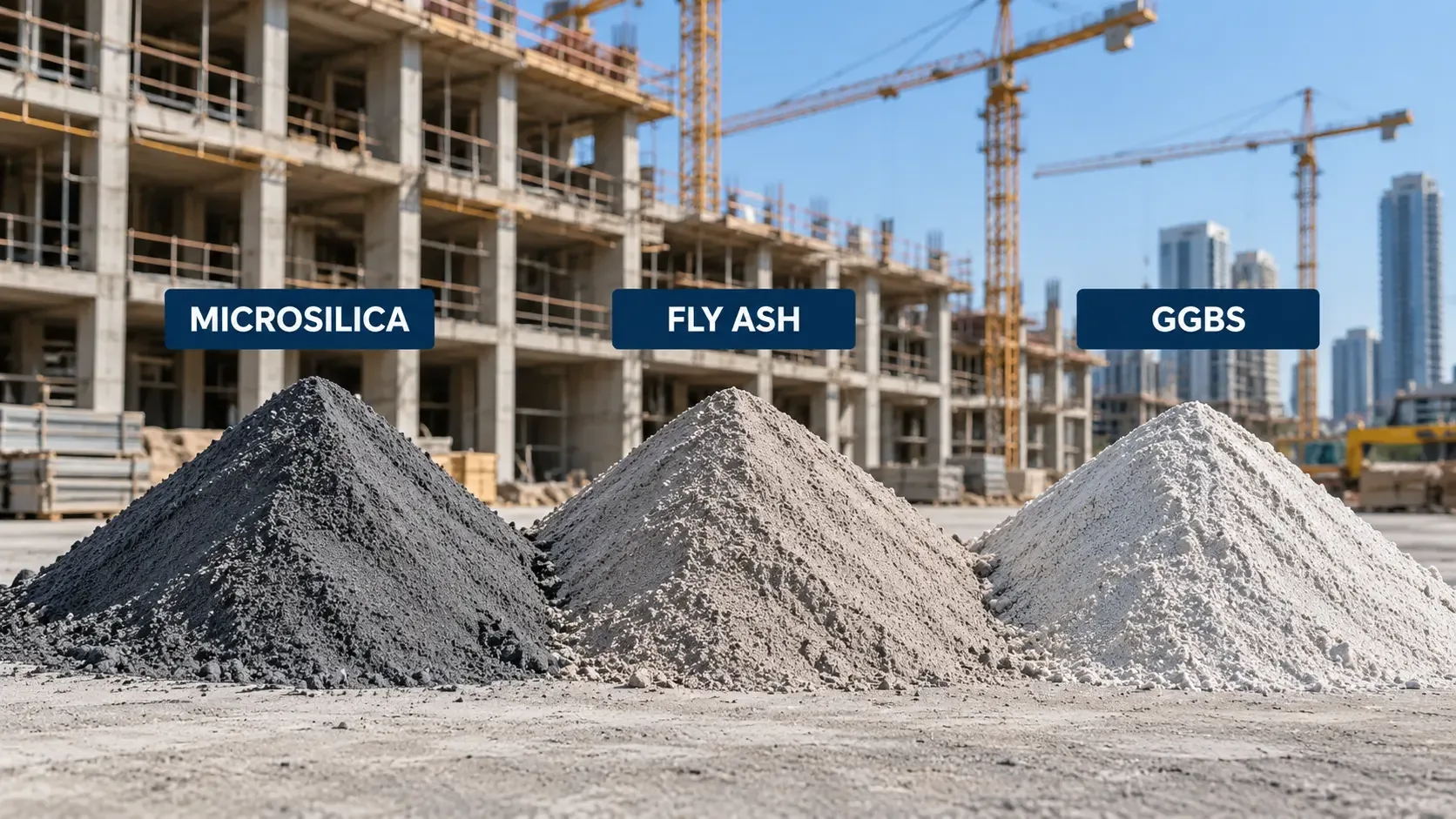
Walk onto almost any major construction site in the UAE and the concrete going into the foundations isn't just cement, sand, aggregate and water. It usually contains at least one supplementary cementitious material (SCM): microsilica, fly ash or ground granulated blast-furnace slag (GGBS).
All three make concrete stronger, denser and longer-lasting, and all three reduce the amount of cement needed. But they work in very different ways, at very different dosages, and they suit different jobs. This guide compares them side by side and explains how to choose for UAE projects.
Quick answer: Microsilica (silica fume) is an ultra-fine, highly reactive pozzolan used at low dosages, typically 5–10% of cement weight, to give high strength and very low permeability. Fly ash is a coarser pozzolan used at higher dosages to improve workability, reduce heat and boost long-term strength, but it gains strength slowly. GGBS is a latent hydraulic binder used at high replacement levels, often 30–70%, to improve durability and cut carbon. In aggressive Gulf conditions, engineers often combine GGBS or fly ash with microsilica in a ternary blend to get both durability and early strength.
What each material is
Microsilica (silica fume)
Microsilica is a by-product of silicon and ferrosilicon alloy production. It's made of extremely fine, glassy particles, around 100 times smaller than cement grains, with a very high amorphous silica content. Because the particles are so small, they fill the gaps between cement grains and react with calcium hydroxide to form extra binding gel. The result is a very dense, low-permeability concrete.
Fly ash
Fly ash is the fine ash collected from coal-fired power station flue gases. Its particles are spherical, which improves workability, and it reacts slowly as a pozzolan. Class F fly ash, the type most used in durable concrete, reduces heat of hydration and gains strength over months rather than days.
GGBS
GGBS is made by rapidly cooling and grinding molten slag from iron blast furnaces. Unlike fly ash and microsilica, it has latent hydraulic properties, meaning it can react with water itself once activated by cement. That's why it can replace a large share of the cement in a mix.
Microsilica vs fly ash vs GGBS: side-by-side comparison
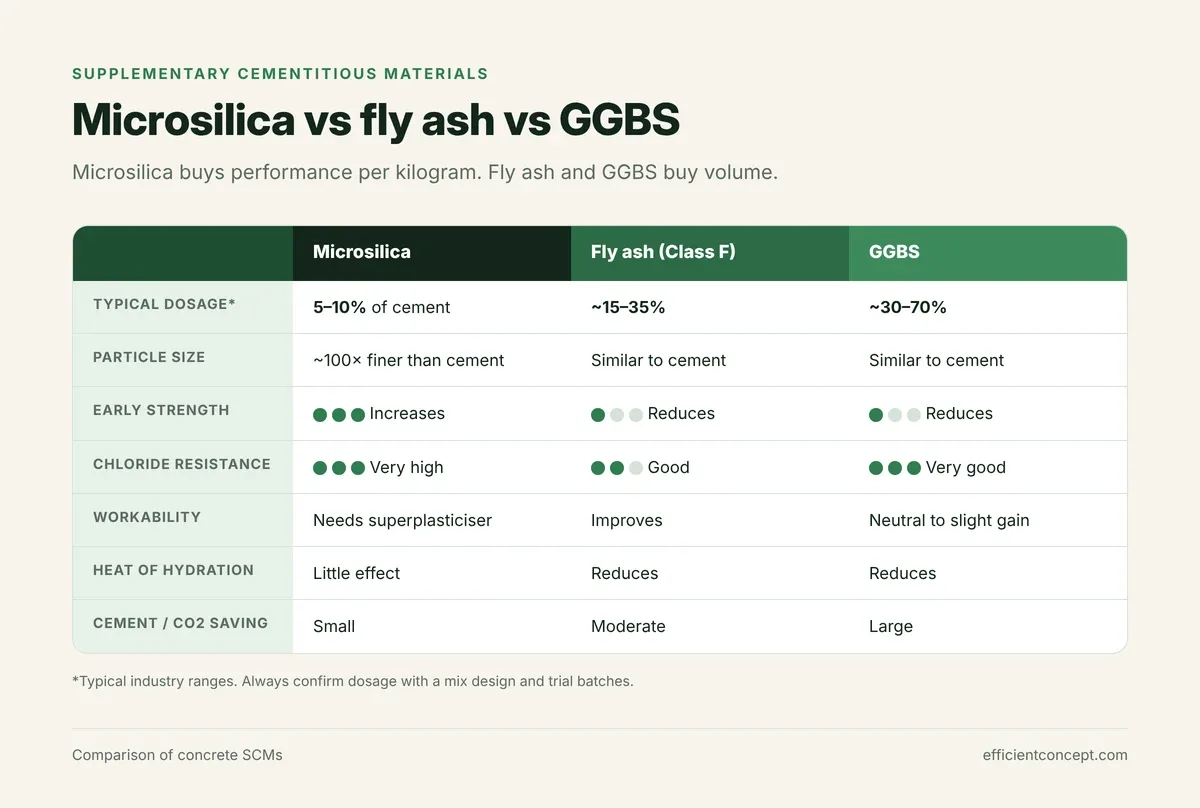
Comparison of microsilica, fly ash and GGBS in concrete by typical dosage, early strength, chloride resistance, workability and carbon reduction
Microsilica | Fly ash (Class F) | GGBS | |
|---|---|---|---|
Source | Silicon and ferrosilicon alloy production | Coal-fired power stations | Iron blast furnaces |
Particle size | Ultra-fine (about 100× finer than cement) | Similar to or slightly finer than cement | Similar to cement |
How it works | Highly reactive pozzolan and micro-filler | Slow-reacting pozzolan | Latent hydraulic binder |
Typical dosage* | 5–10% of cement weight | About 15–35% | About 30–70% |
Early strength | Increases | Reduces | Reduces |
Long-term strength | Strongly increases | Increases | Increases |
Chloride resistance | Very high, even at low dosage | Good | Very good |
Workability | Increases water demand; needs superplasticiser | Improves | Neutral to slightly improves |
Heat of hydration | Little effect | Reduces | Reduces |
Cement and CO2 saving | Small (low dosage) | Moderate | Large (high dosage) |
Curing sensitivity | Needs careful early curing to avoid plastic shrinkage | Needs extended moist curing | Needs extended moist curing |
Typical industry ranges. The right dosage always comes from the mix design and trial batches for your project's materials and exposure.
The pattern is simple: microsilica buys performance per kilogram, while fly ash and GGBS buy volume. A small dose of microsilica can transform permeability and strength. Fly ash and GGBS replace much more cement, which makes them the bigger levers for cutting embodied carbon.
What UAE rules say
The Dubai Building Code makes SCMs standard practice. GGBS or fly ash has been mandatory in structural concrete, and a 2026 Dubai Municipality amendment keeps that requirement for substructures such as foundations, pile caps, rafts, basement walls and retaining walls. Above ground, the amendment relaxes the mandatory requirement for some superstructure elements, while still requiring SCM-containing cements for coastal elements with reduced cover.
Microsilica can be added at the engineer's discretion to improve strength or durability. The amendment also asks consultants not to over-specify strength and durability, because that increases material use and embodied carbon. That's a sensible reminder that the best mix is the one that meets the exposure, not the strongest one possible.
Always check the latest Dubai Municipality circulars and the project specification. Requirements in other emirates may differ.
How to choose
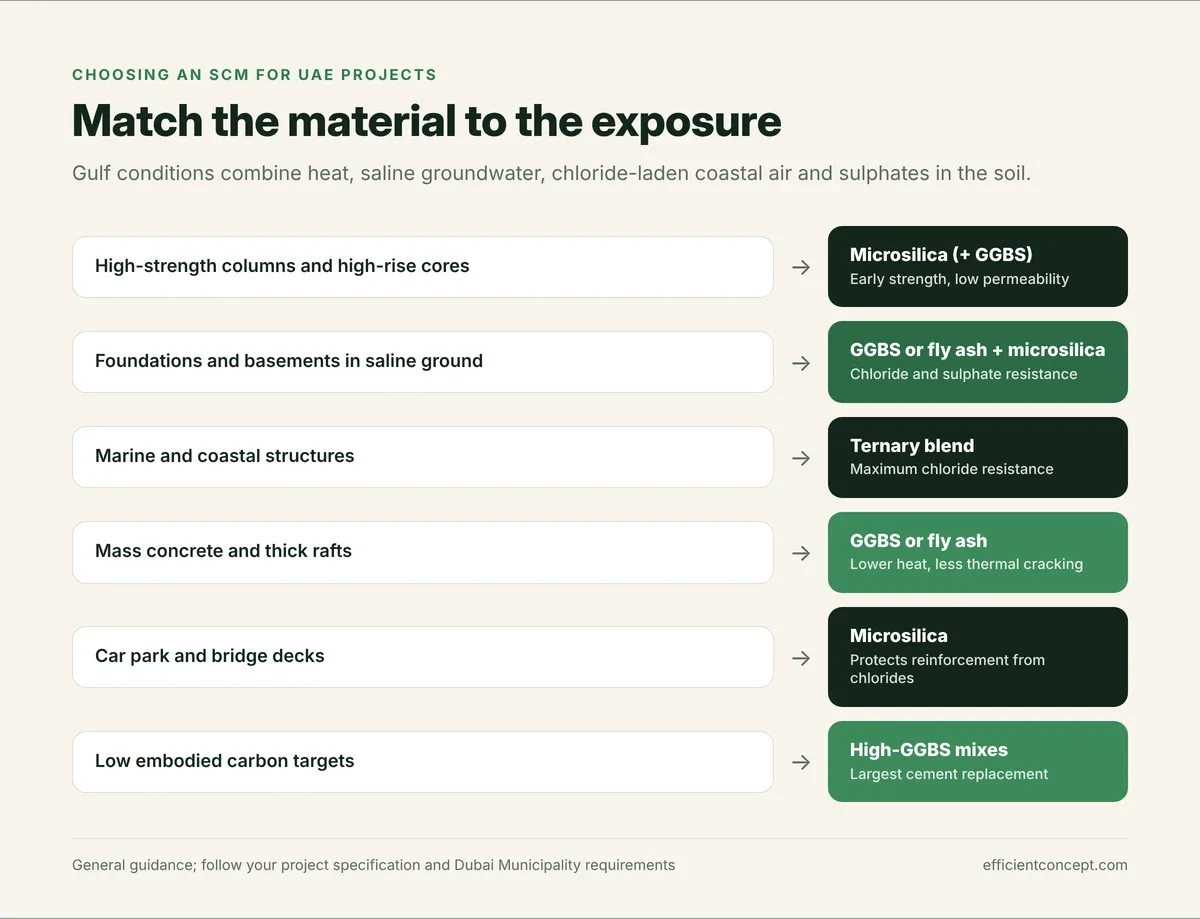
Guide to choosing between microsilica, fly ash, GGBS or a ternary blend based on the concrete application and exposure conditions
Application | Common choice | Why |
|---|---|---|
High-strength columns, high-rise cores | Microsilica, often with GGBS | High early and ultimate strength, low permeability |
Foundations and basements in saline ground | GGBS or fly ash + microsilica | Chloride and sulphate resistance with good early strength |
Marine and coastal structures | GGBS + microsilica (ternary) | Maximum resistance to chloride-induced corrosion |
Mass concrete, thick rafts | GGBS or fly ash | Lower heat of hydration reduces thermal cracking risk |
Car park decks, bridge decks | Microsilica | Low permeability protects reinforcement from chlorides |
Projects targeting low embodied carbon | High-GGBS mixes | Largest cement replacement |
Why ternary blends are popular in the Gulf
Gulf conditions are tough on concrete: high temperatures, saline groundwater, chloride-laden air near the coast and sulphates in the soil. A ternary blend (cement + GGBS or fly ash + microsilica) combines the strengths of each:
GGBS or fly ash provides bulk cement replacement, lower heat and long-term durability.
Microsilica restores early strength and closes the pore structure.
Together, they give a dense, low-permeability concrete that resists chloride penetration.
Research supports this. A 2025 laboratory study of high-strength concrete found that a ternary mix with equal parts fly ash, microsilica and GGBS gave higher 28-day strength and lower chloride permeability than plain cement concrete or most single-SCM mixes.
Common mistakes
Adding microsilica without adjusting the admixture. Microsilica raises water demand. Without enough superplasticiser, workability drops or water gets added on site, which defeats the purpose.
Poor early curing. Microsilica concrete bleeds very little, so surfaces dry out fast in UAE heat. Start curing immediately to prevent plastic shrinkage cracking.
Expecting early strength from high-GGBS or fly ash mixes. Plan formwork stripping and loading around slower early strength gain, or add microsilica.
Choosing on price per tonne alone. Compare the cost per cubic metre of concrete that meets the required strength and durability, not the cost of the additive.
Skipping trial batches. Local cement, aggregates and admixtures behave differently. Always confirm with trials.
Frequently asked questions
What is the difference between silica fume and fly ash?
Silica fume (microsilica) is an ultra-fine, highly reactive pozzolan used at low dosages, typically 5–10% of cement, to give high strength and low permeability. Fly ash is coarser and reacts slowly; it's used at higher dosages to improve workability, reduce heat and increase long-term strength.
Is GGBS better than fly ash?
Neither is universally better. GGBS can replace more cement and gives very good chloride and sulphate resistance. Fly ash improves workability and reduces heat. Choice depends on availability, the specification and the exposure conditions.
Can microsilica be used with GGBS or fly ash?
Yes. Ternary blends of cement, GGBS or fly ash and microsilica are common in aggressive environments such as the Gulf, because they combine high early strength with low permeability and long-term durability.
How much microsilica should be added to concrete?
Microsilica is typically used at 5–10% of cement weight, and sometimes up to about 15% for special applications. The right dosage depends on the mix design and should be confirmed with trial batches.
Are SCMs mandatory in Dubai concrete?
Dubai's building rules have required GGBS or fly ash in structural concrete. A 2026 Dubai Municipality amendment keeps this for substructures but relaxes it for some superstructure elements. Always check the latest circulars and your project specification.
Which SCM reduces carbon emissions the most?
GGBS usually gives the largest carbon reduction because it can replace the most cement, often 30–70%. Microsilica's carbon benefit per mix is smaller because it's used at lower dosages, but it enables durable, longer-lasting structures.
Final thoughts: choose by performance, not habit
Microsilica, fly ash and GGBS aren't competitors so much as tools for different jobs. Fly ash and GGBS cut cement content and heat. Microsilica delivers strength and impermeability. In the Gulf's harsh conditions, combining them is often the smartest route to concrete that lasts.
Efficient Concept (ECMC) supplies high-quality microsilica for ready-mix producers, precast manufacturers and contractors across the UAE, with technical support on dosage and mix design.
Planning a high-performance or marine concrete project? Contact our team or call +971 52 710 0320 for product data, pricing and technical advice.