
UAE Climate Law Explained: What Federal Decree-Law No. 11 of 2024 Means for Your Business in Year Two
By Komal Kazmi 14 min read

The 30 May 2026 compliance date in the UAE climate law has come and gone. Many businesses breathed a sigh of relief when the Ministry of Climate Change and Environment (MOCCAE) signalled that the date would likely be extended. But here is the part that's easy to miss: the calendar moved, the workload didn't.
Your 2026 electricity bills, generator fuel logs and refrigerant top-ups are already becoming the emissions data you'll be asked to report. If that data is scattered across finance, facilities and three different landlords, year two of the UAE climate law is the time to fix it.
This guide explains what Federal Decree-Law No. 11 of 2024 actually requires, what is still unclear, and what a practical, low-stress compliance plan looks like for UAE businesses right now.
Quick answer: The UAE climate law (Federal Decree-Law No. 11 of 2024) makes it mandatory for organisations in the UAE, including free-zone companies, to measure, report and reduce their greenhouse gas emissions. It entered into force on 30 May 2025, with a one-year transition to 30 May 2026. MOCCAE has indicated that date will likely be extended until its technical guidance is published, but reporting years are already running. Fines range from AED 50,000 to AED 2,000,000 and can double for repeat violations. The smart move now is to build a reliable Scope 1 and Scope 2 data baseline, starting with your energy data.
What is the UAE climate law?
The UAE climate law is Federal Decree-Law No. (11) of 2024 on the Reduction of Climate Change Effects. It was issued on 28 August 2024 and came into force on 30 May 2025. In simple terms, it turns emissions management from a voluntary ESG activity into a legal obligation.
It works alongside a second instrument, Cabinet Resolution No. 67 of 2024, which created the National Register for Carbon Credits and sets stricter rules for the country's largest emitters.
The law rests on three duties:
Measure your greenhouse gas (GHG) emissions using approved methods.
Report them periodically to MOCCAE or your emirate's competent authority.
Reduce them through recognised measures such as energy efficiency and clean energy.
A fourth, quieter duty matters just as much in practice: keep records. Supporting data must be retained so it can be checked later.
It also connects to the bigger picture. The UAE has a Net Zero 2050 target, and the buildings sector is one of the largest energy users in the country. If you want background on why buildings sit at the centre of this, our article on why retrofitting is key to energy efficiency and net-zero goals is a good starting point.
Who must comply with the UAE climate law?
The short answer: potentially almost everyone. The law applies to emission "sources" in the UAE, defined broadly as public and private legal entities and individual enterprises whose activities release greenhouse gases. Free zones are expressly included, so a DMCC, JAFZA or DAFZA licence is not an exemption.
The Decree-Law itself sets no threshold based on company size, sector or emissions. Instead, MOCCAE or an emirate-level authority decides which sources must report. Until national technical guidance is published, the practical picture looks like this:
Who you are | What applies today |
|---|---|
Large emitter: 0.5 million tonnes CO2e or more per year (Scope 1 and 2 combined) | Cabinet Resolution No. 67 of 2024: register with the National Register for Carbon Credits, report Scope 1 and 2 annually under the GHG Protocol, and have emissions verified by an ISO 14065-accredited, MOCCAE-authorised verifier |
Facility in Abu Dhabi in industry, power and water, oil and gas, or land transport, emitting 25,000 tonnes CO2e or more of Scope 1 a year | Abu Dhabi MRV system: annual facility-level Scope 1 report to the Environment Agency – Abu Dhabi by 31 March |
Facility in those Abu Dhabi sectors below 25,000 tonnes | Submit at least one year of data to confirm you're below the threshold |
Every other business (offices, retail, hotels, hospitals, schools, logistics, light industry) | Covered by the Decree-Law in principle; detailed thresholds, scopes and dates are expected in MOCCAE's technical guidance |
That last row is where most UAE companies sit. Legal analysts expect national thresholds similar to Abu Dhabi's once guidance arrives. But no one can promise your business will fall below them, and banks, tenants and multinational parent companies are already asking for emissions data regardless.
What about Scope 3?
The Decree-Law doesn't name specific scopes. The large-emitter rules and most market practice focus on Scope 1 and Scope 2. Scope 3 (value-chain emissions such as suppliers, business travel and waste) is not a confirmed requirement today, although many advisers expect it to come later. Treat it as a "prepare, don't panic" item.
What the law requires: measure, report, reduce, record
1. Measure your emissions
You need a GHG inventory for your UAE operations. In practice that means two buckets:
Scope 1 (direct): fuel burned in generators, boilers and company vehicles, plus refrigerant leaks from chillers and AC units.
Scope 2 (indirect): electricity, and in many UAE buildings district cooling, that you buy from someone else.
The GHG Protocol Corporate Standard is the method most UAE frameworks point to, and the large-emitter rules require it explicitly.
2. Report through the national system
MOCCAE launched the National MRV (Measurement, Reporting and Verification) Transparency System in October 2025, together with the Integrated Emissions Quantification Tool (IEQT), at mrv.ae. According to the Decree-Law, an emissions inventory report should cover:
emissions from activities and operations inside the UAE
the activities that cause those emissions
reduction measures already in place
planned reduction measures
the results you expect from them
Notice that three of those five items are about reduction, not measurement. A report that only contains a tonnage figure is incomplete.
3. Reduce your emissions
The law asks organisations to contribute to carbon neutrality through one or more recognised measures:
improving energy efficiency
using clean energy
protecting and enhancing natural carbon sinks
carbon capture, use and storage
using alternatives to saturated fluorocarbons
carbon offsetting
integrated waste management
The Decree-Law doesn't yet set a mandatory reduction percentage or timeline. For most commercial and industrial businesses, though, energy efficiency and clean energy are the fastest and cheapest levers, and they usually pay for themselves. Our guide to energy efficiency as your fastest ROI explains the business case. For clean electricity claims, renewable energy certificates are the recognised route, which we cover on our I-REC services page.
Offsetting is on the list, but it's best used for residual emissions after you've cut what you can. Our article on why carbon credits matter in corporate sustainability strategies explains where they fit.
4. Keep auditable records
The data behind your numbers (bills, meter readings, fuel receipts, refrigerant logs and calculation files) must be kept and available to the authorities on request. Many advisers cite a minimum of five years. If a verifier or the ministry asks how you got a figure, you need to be able to show them.
Key dates: where things stand in year two
Date | What happened or happens |
|---|---|
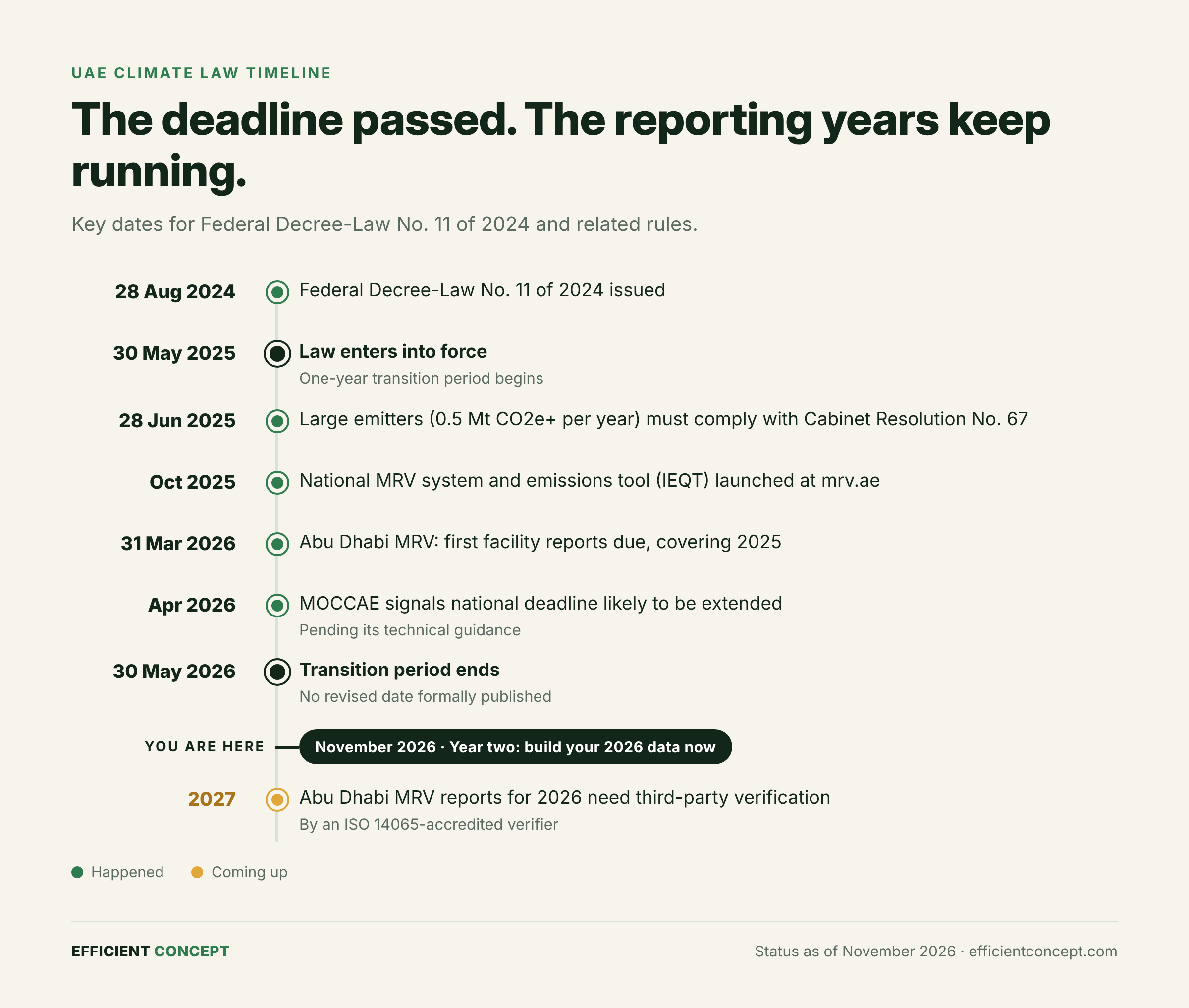
28 August 2024 | Federal Decree-Law No. 11 of 2024 issued |
30 May 2025 | Law enters into force; one-year transition begins |
28 June 2025 | Deadline for large emitters (0.5 Mt CO2e+) to comply with Cabinet Resolution No. 67 |
October 2025 | National MRV system and IEQT launched |
31 March 2026 | Abu Dhabi MRV: first reports due for calendar year 2025 |
April 2026 | MOCCAE representatives indicate the national deadline is expected to be extended pending technical guidance |
30 May 2026 | Transition period in the Decree-Law ends; no revised date formally published |
2027 (reporting year 2026) | Abu Dhabi MRV reports must be independently verified by an ISO 14065-accredited verifier |
What "year two" really means
At the time of writing (November 2026), MOCCAE's technical guidance and any revised national date have not been formally published. That creates a tempting but risky mindset: "We'll wait until they tell us exactly what to do."
Here is why waiting is a mistake:
Reporting is backward-looking. Whatever date is announced, you'll be reporting on a period that has already happened. Data you don't capture this year is very hard to reconstruct next year.
A credible baseline takes about 12 months of data. If you start collecting in mid-2027, you may not have a full, defensible year until 2028.
Verification is coming. Abu Dhabi's facility-level reports for 2026 will need third-party verification in 2027. Verifiers don't accept estimates you can't trace back to a bill or a meter.
Other people already want your numbers. Lenders, international parent companies, tenants and EU customers subject to CBAM are asking for emissions data now, law or no law.
In short, an extension buys you preparation time, not immunity.
Penalties under the UAE climate law
Violation | Penalty |
|---|---|
Breaching measurement, reporting or record-keeping duties under the Decree-Law | Fine of AED 50,000 to AED 2,000,000 |
Repeat violation within two years of a final conviction | Fine can be doubled |
Large emitters breaching Cabinet Resolution No. 67 | Up to AED 500,000 (first), AED 1,000,000 (second), AED 2,000,000 (subsequent) |
Further administrative penalties are expected in a future Cabinet Resolution. In Abu Dhabi, the Environment Agency can first issue a written notice listing the violation and the corrective action needed, with the Decree-Law fines applied if a company doesn't fix the problem in time.
The fines are significant, but for most businesses the bigger risks are indirect: reputational damage, harder conversations with banks, and losing tenders or customers who require emissions disclosure.
The part most guides skip: your emissions data is really energy data
Most articles about the UAE climate law focus on legal duties or reporting software. Both matter. But software can only calculate what you feed it, and for most UAE businesses the biggest number in the inventory comes straight from energy use.
In a typical office, mall, hotel or hospital in the UAE, purchased electricity and cooling make up the large majority of reported emissions. That means the quality of your climate law report depends on the quality of your energy data.
A worked example
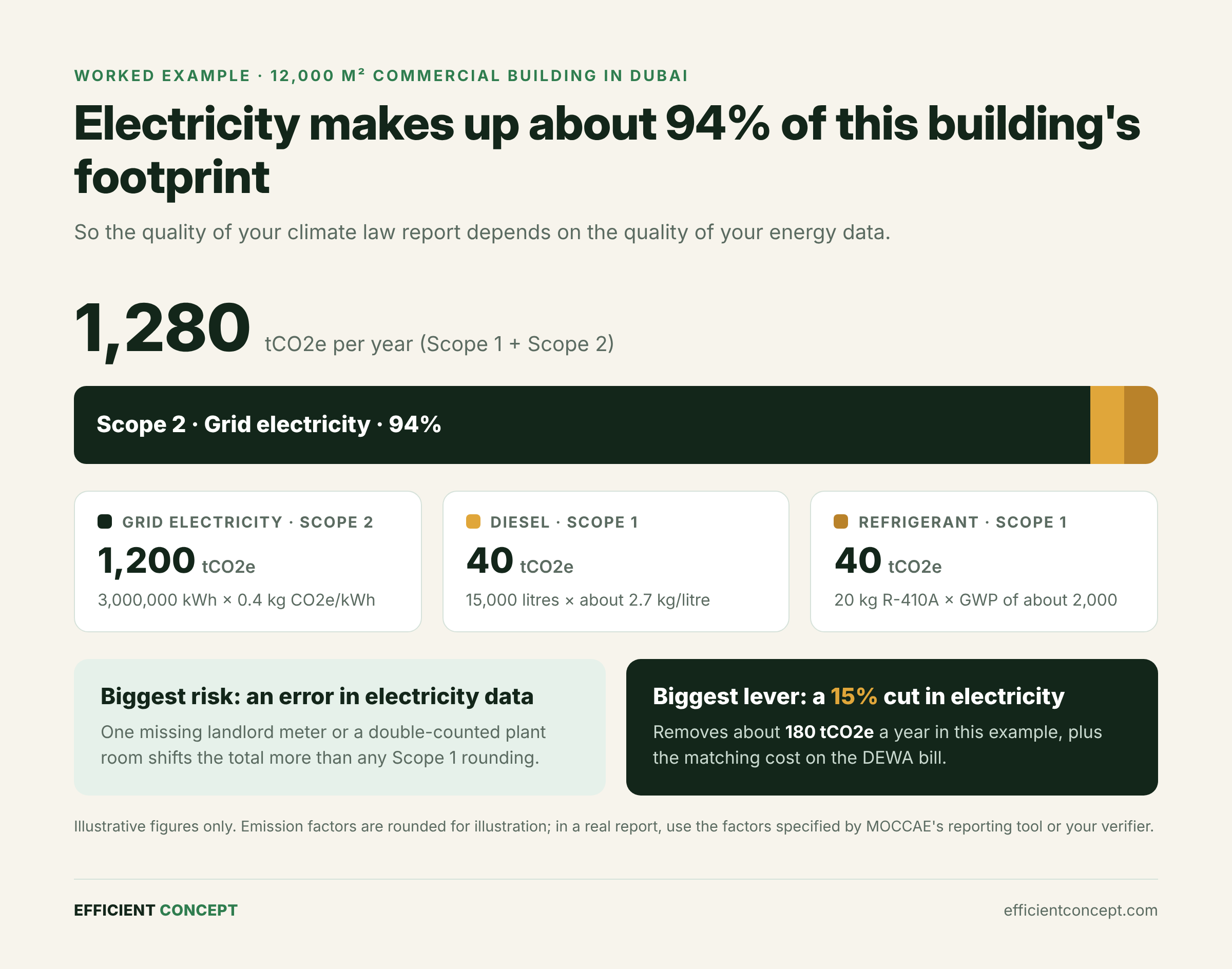
Here is an illustrative inventory for a 12,000 m² commercial building in Dubai. The emission factors are rounded for illustration only. In a real report, use the factors MOCCAE's tool or your verifier specifies.
Source | Annual activity data | Illustrative factor | Emissions (tCO2e) |
|---|---|---|---|
Grid electricity (Scope 2) | 3,000,000 kWh | 0.4 kg CO2e per kWh | 1,200 |
Diesel for backup generators (Scope 1) | 15,000 litres | about 2.7 kg CO2e per litre | 40 |
Refrigerant top-up, R-410A (Scope 1) | 20 kg | GWP of roughly 2,000 | 40 |
Total | 1,280 |
In this example, electricity is about 94% of the footprint. Two things follow:
An error in your electricity data is an error in nearly your whole report. Missing one landlord-billed meter, or counting a shared plant room twice, shifts the total by far more than any Scope 1 rounding.
Your biggest reduction lever is also in the electricity line. If an energy audit finds that chillers run 24/7 when the building is occupied 12 hours a day, a 15% cut in consumption removes roughly 180 tCO2e a year in this example, along with the matching cost on your DEWA bill.
Where UAE companies usually get stuck
When we review energy data for clients, the same gaps come up again and again:
Landlord-paid electricity. Tenants in multi-tenant towers often see energy only as part of a service charge, with no kWh figure at all.
District cooling. Chilled water is billed in ton-hours, not kWh, and needs its own conversion and emission factor from the provider.
Multiple utility accounts. Portfolios with dozens of DEWA, ADDC/AADC, SEWA or FEWA accounts rarely have one clean list of which account serves which site.
Refrigerant records. Top-up quantities usually sit with the facilities management contractor, not in any company system.
No sub-metering. Without it, you can report a total but can't explain where the energy goes or prove that a reduction measure worked.
How an energy audit closes those gaps
A good energy audit does more than suggest new equipment. It produces exactly the evidence trail the climate law and future verifiers will ask for: a reconciled list of meters and accounts, 12 to 36 months of consumption analysis, a breakdown by system (HVAC, lighting, plug loads, pumps), and a costed list of savings measures.
That is why we suggest treating your first climate law inventory and your energy audit as one project rather than two. If you want to see what that process looks like in a Dubai context, read our guide on how an energy audit in Dubai identifies cost-saving opportunities before retrofits, and our explainer on how energy audits transform data into carbon savings.
For new buildings, major refurbishments, or measures you want to test before spending money, energy modelling lets you forecast how much a change will cut consumption, and therefore emissions, before you commit capital.
A practical year-two compliance plan
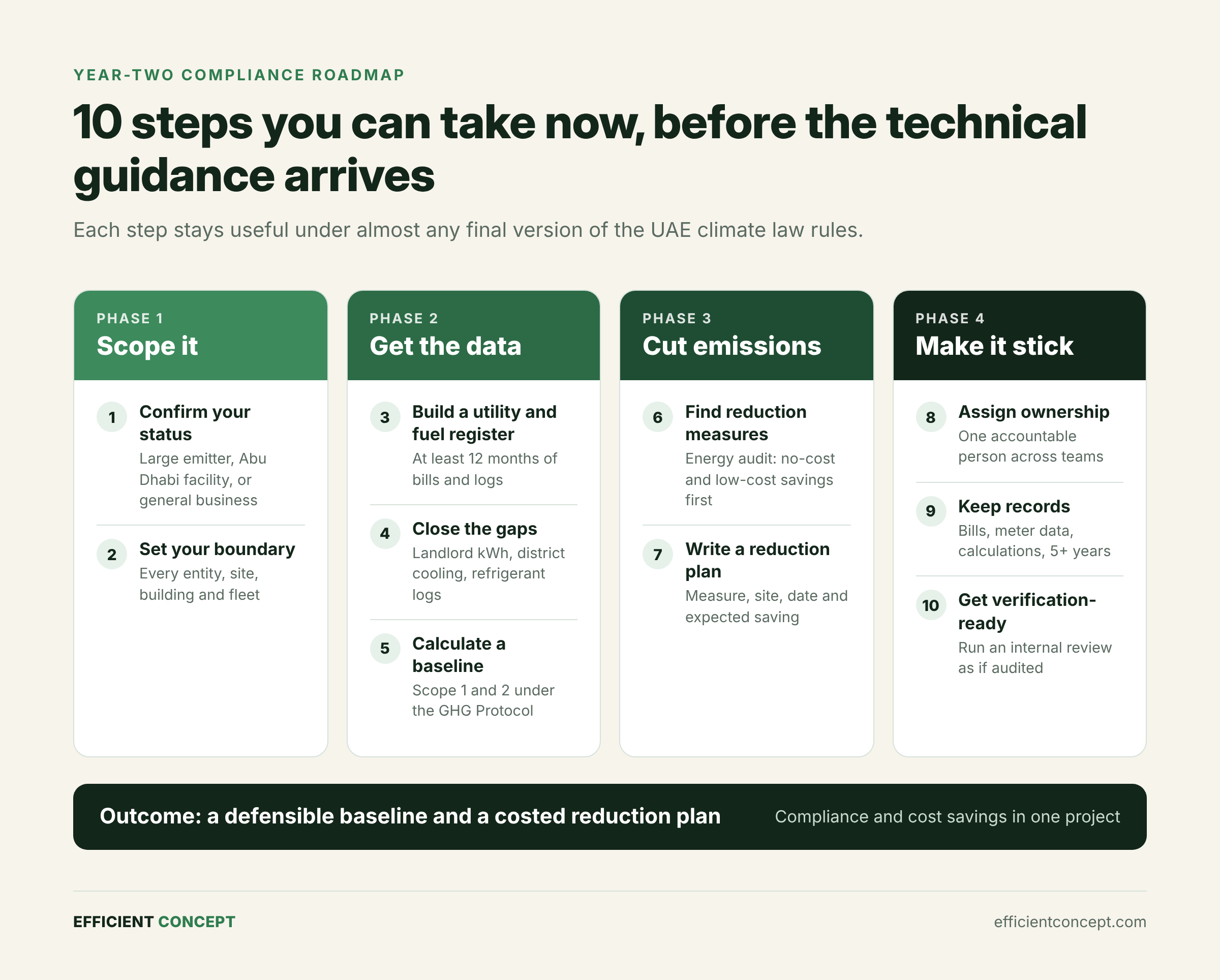
You don't need to wait for the technical guidance to make real progress. These steps are useful under almost any final version of the rules.
Confirm your status. Check whether you are a large emitter (0.5 Mt CO2e+), an Abu Dhabi facility in a covered sector, or a general business waiting for national thresholds. Note any communication you receive from MOCCAE or your emirate's authority.
Set your boundary. List every UAE entity, site, building and vehicle fleet you operate or control. Decide early how you'll treat leased spaces and shared buildings.
Build a utility and fuel register. Gather every electricity, district cooling, gas and water account, plus generator and vehicle fuel records, for at least the last 12 months.
Close the data gaps. Ask landlords for metered kWh, request ton-hour data from your district cooling provider, and get refrigerant logs from your FM contractor.
Calculate a Scope 1 and Scope 2 baseline. Use the GHG Protocol and document every factor and assumption so a verifier can follow it.
Find your reduction measures. Commission an energy audit to identify no-cost and low-cost savings first, such as scheduling, setpoints and BMS overrides, before capital projects.
Write a reduction plan with numbers and dates. The Decree-Law expects current and planned measures and their expected results. "We will improve efficiency" is not a plan; "chiller sequencing upgrade at Tower B by Q2 2027, saving 400 MWh and about 160 tCO2e a year" is.
Assign ownership. Name one person accountable for climate reporting, with support from finance, facilities and procurement.
Set up record-keeping. Store bills, meter data, fuel receipts and calculation files in one place, retained for at least five years.
Get ready for verification. Even if you're not required to be verified yet, run an internal review as if you were.
For government entities and semi-government organisations, steps 8 and 10 often need new skills inside the team. That is where structured institutional capacity building for the public sector helps build in-house MRV and energy management capability rather than relying on consultants forever.
Common mistakes to avoid
Assuming a free-zone licence means you're exempt. The law expressly covers free zones.
Treating the expected extension as a reason to pause. It changes the filing date, not the period you'll report on.
Reporting Scope 1 only. For most offices and commercial buildings, Scope 2 is the bigger number.
Using estimates you can't trace. "Approximately 2 GWh" won't survive a verifier. Every figure needs a bill, meter reading or documented calculation behind it.
Buying offsets before cutting waste. Paying for credits while chillers run overnight in an empty building is hard to defend, and expensive. See our article on the hidden cost of building energy waste in UAE commercial properties.
Writing a vague reduction plan. Name the measure, the site, the date and the expected saving.
Leaving it all to one department. Finance holds the bills, facilities holds the meters, and procurement holds the contracts. Climate reporting needs all three.
Frequently asked questions
What is the UAE climate law?
The UAE climate law is Federal Decree-Law No. 11 of 2024 on the Reduction of Climate Change Effects. It requires public and private organisations in the UAE to measure, report and reduce their greenhouse gas emissions and keep supporting records.
Does the UAE climate law apply to free-zone companies?
Yes. The law applies to emission sources across the UAE, including free zones. A free-zone licence does not exempt a company.
Has the 30 May 2026 deadline been extended?
MOCCAE representatives indicated in April 2026 that the deadline is expected to be extended once technical guidance is issued. As of November 2026, no revised date has been formally published, so businesses should keep preparing.
Do small businesses have to report emissions?
The Decree-Law sets no size threshold, and MOCCAE or emirate authorities decide which sources must report. National thresholds are expected in the technical guidance. Small businesses should at least start tracking their energy and fuel data now.
Which emissions must be reported: Scope 1, 2 or 3?
The large-emitter rules require Scope 1 and Scope 2 under the GHG Protocol, and most guidance expects the same for other businesses. Scope 3 is not a confirmed requirement today.
What are the penalties for non-compliance?
Fines range from AED 50,000 to AED 2,000,000 for breaches of measurement, reporting or record-keeping duties, and can double for repeat violations within two years.
Where do UAE companies submit their emissions reports?
Through MOCCAE's National MRV Transparency System and its Integrated Emissions Quantification Tool at mrv.ae. In-scope Abu Dhabi facilities report to the Environment Agency – Abu Dhabi.
How can an energy audit help with UAE climate law compliance?
For most businesses, electricity and cooling are the largest source of reported emissions. An energy audit reconciles meters and bills into reliable Scope 2 data and identifies the reduction measures the law asks you to report.
Final thoughts: turn compliance into savings
Year two of the UAE climate law isn't about rushing to meet a date. It's about building data you can trust and a reduction plan you can defend. The companies that do this well will find that compliance and cost control are the same project: every kilowatt-hour you stop wasting is a lower bill and a smaller number on your emissions report.
At Efficient Concept, we help UAE organisations turn scattered utility data into a clear energy and emissions baseline, find practical savings through energy audits and energy modelling, and back clean-energy claims with I-RECs.
Not sure where your business stands? Book a free initial consultation with our Dubai team, or call +971 52 710 0320. We'll help you see what data you already have, what's missing, and where the quickest savings are.
This article is for general information and is not legal advice. The UAE climate law framework is still evolving, so please check the latest MOCCAE guidance and seek legal advice for your specific situation.