

ASHRAE Level 1, 2 and 3 Energy Audits Explained
By Osman Masood 8 min read

Ask three consultants for an "energy audit" quote and you may get three very different proposals: one for a two-day walkthrough, one for a four-week engineering study, and one for a three-month investment-grade analysis. They're all called energy audits, but they answer very different questions.
The international reference for sorting this out is ASHRAE, which defines three levels of commercial building energy audit in ASHRAE Standard 211. Knowing what each level includes helps you buy the right audit, compare proposals fairly and avoid paying for detail you don't need yet, or skipping detail you do.
Quick answer: ASHRAE defines three levels of energy audit. A Level 1 audit is a walk-through and utility bill analysis that benchmarks your building and finds obvious savings. A Level 2 audit is a detailed energy survey that breaks down where energy goes and costs out specific savings measures. A Level 3 audit is an investment-grade analysis, usually with extra metering and a calibrated energy model, used to justify major capital projects, financing or energy performance contracts. Most UAE buildings start with Level 1 or 2; Level 3 is for large retrofits and guaranteed-savings contracts.
The three ASHRAE energy audit levels explained
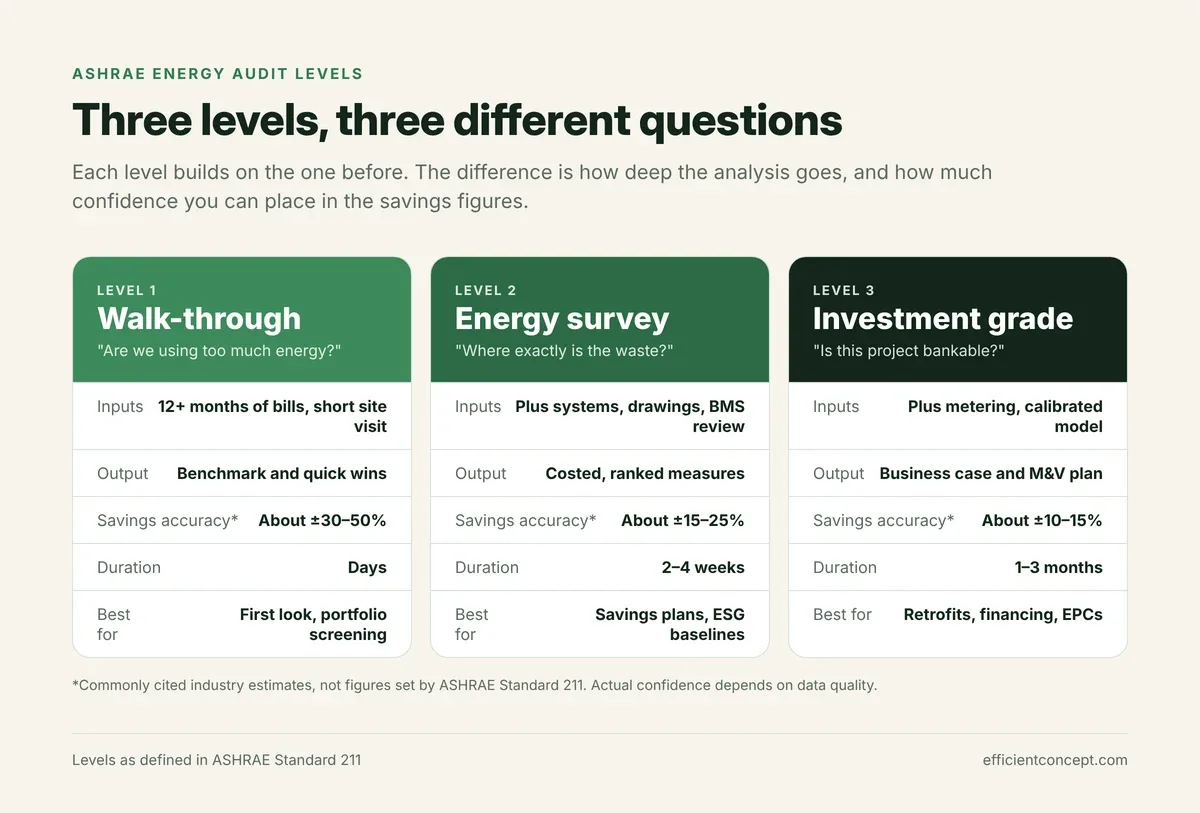
Each level builds on the one before it. The difference is how deep the analysis goes, and how much confidence you can place in the savings figures.
Level 1: Walk-through analysis
A Level 1 audit is a screening exercise. The auditor analyses at least 12 months of utility bills, calculates your building's energy use intensity (EUI, in kWh/m² per year), benchmarks it against similar buildings, and spends a few hours walking the site and talking to facilities staff.
You get: a benchmark, a list of obvious no-cost and low-cost measures, and a view of whether a deeper audit is worth it.
Typical timeframe: a few days, including the report.
Level 2: Energy survey and analysis
A Level 2 audit is where most real decisions get made. The auditor inventories the major energy-using systems (chillers, AHUs, pumps, lighting, controls), reviews drawings and BMS sequences, takes spot measurements and builds an end-use breakdown showing where the energy actually goes.
You get: a ranked list of energy efficiency measures, each with estimated savings, cost and simple payback, plus how measures interact. For example, LED lighting reduces cooling load as well as lighting energy.
Typical timeframe: two to four weeks, depending on the building.
Level 3: Detailed analysis of capital-intensive measures
A Level 3 audit, often called an investment-grade audit, is for decisions involving significant capital. It adds extended monitoring (data loggers, BMS trend data, sub-metering) and usually a whole-building energy model calibrated to real consumption.
You get: detailed savings and cost estimates for major measures, life-cycle cost analysis, implementation guidance and, typically, a measurement and verification (M&V) plan.
Typical timeframe: one to three months.
Side by side
Level 1 | Level 2 | Level 3 | |
|---|---|---|---|
Also called | Walk-through, preliminary | Energy survey and analysis | Investment-grade audit |
Main inputs | 12+ months of bills, short site visit | Plus system inventory, drawings, BMS review, spot measurements | Plus extended metering and a calibrated energy model |
Output | Benchmark and quick wins | Costed, ranked savings measures | Bankable business case for major projects |
Typical savings accuracy* | Order of magnitude (about ±30–50%) | About ±15–25% | About ±10–15% |
Typical duration | Days | 2–4 weeks | 1–3 months |
Best for | First look, portfolio screening | Operational and retrofit planning | Large retrofits, financing, performance contracts |
Accuracy ranges are commonly cited industry estimates, not figures set by the standard. Actual confidence depends on data quality and the building.
Which audit level do you need?
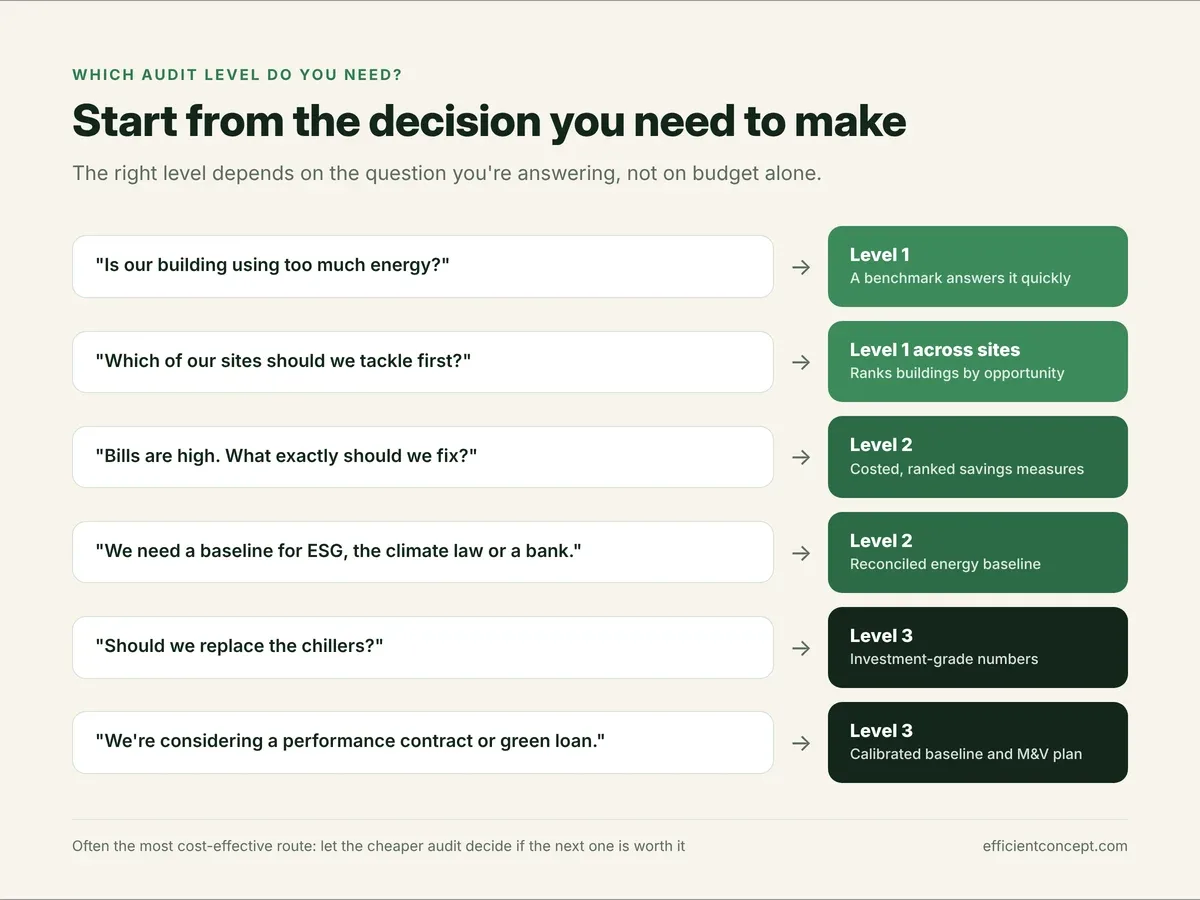
The right level depends on the decision you're trying to make, not on the size of your budget alone. Start from the question you need answered.
Your situation | Recommended level | Why |
|---|---|---|
"Is our building using too much energy?" | Level 1 | A benchmark answers this quickly and cheaply |
You manage a portfolio and need to know where to start | Level 1 across sites | Ranks buildings by opportunity before you spend more |
Bills are high and you want a practical savings plan | Level 2 | Gives costed, ranked measures you can act on |
You need data for ESG reporting, the UAE climate law or a bank | Level 2 | Produces a reconciled energy baseline and end-use breakdown |
You're planning a chiller replacement or major retrofit | Level 3 | Capital decisions need investment-grade numbers |
You're considering an energy performance contract or green loan | Level 3 | Guaranteed savings and financing need a calibrated baseline and M&V plan |
The UAE context: why Level 2 is often the sweet spot
In UAE commercial buildings, cooling usually dominates electricity use, and many of the biggest savings come from how chillers, pumps and controls are operated rather than from new equipment. A Level 1 audit can spot the symptoms (a high EUI, chillers running overnight), but it takes a Level 2 survey of the BMS, chiller sequencing and setpoints to put a reliable number on each fix.
Level 3 has its place too. Dubai's energy service company model, run through Etihad ESCO, relies on investment-grade audits because savings are guaranteed contractually. If you're heading toward a retrofit funded by savings or by a green loan, plan for Level 3. Our guide on what UAE banks now ask about ESG explains why lenders value this kind of evidence.
A practical example
Consider an illustrative 12,000 m² office building in Dubai with high utility bills.
Level 1: Bill analysis shows an EUI of about 290 kWh/m², well above what a comparable efficient office would use. A walk-through finds chillers running through the night and corridor lighting on 24/7.
Level 2: A detailed survey shows cooling accounts for over half of consumption. It costs out five measures, including BMS schedule correction, chilled water reset, chiller sequencing, LED lighting and pump variable speed drives, with an estimated combined saving of around 20%.
Level 3 (only if needed): The owner wants to replace two ageing chillers. A Level 3 study with trend logging and a calibrated model confirms the savings and payback of the replacement before committing capital.
Figures are illustrative. Actual results depend on the building and how it's operated.
Notice the sequence: the cheapest audit guides whether the next one is worth paying for. That's often the most cost-effective route.
How to prepare for an energy audit
Good preparation shortens the audit and improves its accuracy. Before the auditor arrives, gather:
12 to 36 months of electricity, district cooling, gas and water bills for every account
Floor areas, occupancy hours and any changes in use during that period
Mechanical and electrical drawings, and the chiller and AHU schedules
BMS access or trend data exports
Maintenance records and recent equipment replacements
A contact in facilities management who knows how the building really runs
Common mistakes when buying an energy audit
Comparing proposals that aren't the same level. A cheap quote may be a Level 1 while another is a Level 2. Ask each consultant which ASHRAE level they're proposing.
Jumping straight to Level 3. Without a Level 1 or 2 first, you may fund detailed analysis of the wrong measures.
Stopping at Level 1 for a capital decision. Order-of-magnitude estimates aren't enough to justify a chiller replacement.
Missing landlord or shared meters. Incomplete data produces a misleading baseline.
Treating the report as the finish line. Savings only happen when measures are implemented and verified.
If you're wondering how an audit differs from a simulation-based study, read our upcoming guide on energy modelling vs energy audit.
Frequently asked questions
What are the three levels of ASHRAE energy audit?
ASHRAE defines Level 1 (walk-through analysis), Level 2 (energy survey and analysis) and Level 3 (detailed analysis of capital-intensive modifications, often called an investment-grade audit). Each level adds more data, analysis and confidence in the savings estimates.
What is the difference between a Level 1 and Level 2 energy audit?
A Level 1 audit benchmarks your energy use and identifies obvious savings from bills and a short site visit. A Level 2 audit surveys the building's systems in detail, breaks down energy use by end use and provides costed savings measures with payback periods.
What is an investment-grade energy audit?
An investment-grade energy audit is an ASHRAE Level 3 audit. It uses extended metering and usually a calibrated energy model to produce savings and cost estimates reliable enough to support major capital investment, financing or energy performance contracts.
How long does an energy audit take?
As a guide, a Level 1 audit takes a few days, a Level 2 audit two to four weeks, and a Level 3 audit one to three months, depending on the building's size and complexity.
Which energy audit level is best for UAE commercial buildings?
Many UAE commercial buildings benefit most from a Level 2 audit, because large savings often come from chiller operation, BMS schedules and controls, which need a detailed survey to quantify. Level 3 is best for major retrofits and performance contracts.
What is ASHRAE Standard 211?
ASHRAE Standard 211 is the standard for commercial building energy audits. It sets a common scope, minimum analysis and minimum reporting requirements for Level 1, 2 and 3 audits.
Final thoughts: match the audit to the decision
The best energy audit isn't the most detailed one. It's the one that answers the decision in front of you with enough confidence to act. Start with a benchmark, move to a costed plan, and save investment-grade analysis for the projects that need it.
For most UAE buildings, that path leads to real savings quickly, often from operational fixes before any new equipment is bought. And the data you gather supports UAE climate law reporting and ESG requests along the way.
At Efficient Concept (ECMC), we carry out energy audits at all three ASHRAE levels for commercial, industrial and public sector buildings across the UAE, and use energy modelling where investment-grade analysis is needed.
Not sure which level fits your building? Book a free initial consultation with our Dubai team, or call +971 52 710 0320. We'll look at your bills and recommend the right starting point.