The Deep Energy Retrofit Advantage: How ECMC Transforms Existing Buildings into High-Performance Assets?
While gleaming new net-zero buildings capture headlines, the uncomfortable reality is that existing buildings constitute 97% of global building stock—and they’re responsible for nearly 40% of worldwide carbon emissions. Demolishing and rebuilding isn’t viable environmentally or economically. The path to decarbonization runs directly through the retrofitting of what we’ve already built.
Deep energy retrofitting—comprehensive upgrades to a building’s thermal envelope, mechanical systems, and operational intelligence—represents the single most impactful strategy for reducing the built environment’s carbon footprint while enhancing asset value. Unlike superficial improvements that swap lightbulbs and add occupancy sensors, deep retrofitting fundamentally re-engineers how a building breathes, consumes energy, and interacts with its occupants.
At ECMC, we specialize in these transformational retrofits, converting energy liabilities into high-performance assets that meet—or exceed—modern sustainability standards without the environmental cost of new construction.
Beyond Weatherization: Defining Deep Energy Retrofits
The term “retrofit” often conjures images of caulk guns and attic insulation. While valuable, these measures represent shallow interventions. Deep energy retrofitting involves systemic upgrades to:
- The Thermal Envelope: High-performance insulation, advanced glazing, and continuous air barrier systems that eliminate thermal bridging
- Mechanical Systems: HVAC replacement with heat pumps, energy recovery ventilation (ERV), and smart controls
- Airtightness Architecture: Installation of intelligent membranes and grommet systems that eliminate uncontrolled infiltration
- Renewable Integration: Solar PV and thermal systems sized for optimized load profiles created by reduced demand
This holistic approach distinguishes ECMC’s methodology: we don’t treat symptoms (high utility bills) with isolated tactics. We redesign building physics to create passive survivability—structures that maintain livable conditions even during grid failures or extreme weather events.
The Multi-Dimensional Value Proposition
1. Energy Performance: From Leaky Liability to Efficiency Asset
Deep retrofits deliver 50-80% reductions in energy demand—not merely marginal improvements. By addressing the “fabric first” (the building envelope before mechanical systems), ECMC reduces heating and cooling loads so dramatically that conventional HVAC equipment can be downsized or eliminated entirely.
The airtightness component proves critical. Uncontrolled air leakage accounts for 30-50% of thermal energy loss in existing structures. ECMC’s envelope sealing protocols—utilizing vapor-smart membranes and precision detailing around penetrations—achieve airtightness levels below 1.0 ACH50 (air changes per hour at 50 Pascals), approaching Passive House standards. This isn’t merely about energy savings; it’s about controlling the controllable—ensuring every cubic meter of conditioned air serves its intended purpose.
2. Carbon Reduction: Realizing Net-Zero Trajectories
For organizations committed to Science Based Targets or net-zero carbon commitments, existing real estate portfolios represent the largest obstacle. Deep retrofitting offers operational carbon reductions of 60-90%, with remaining loads addressable through high-efficiency heat pumps and renewable energy.
But the benefits extend beyond operational carbon. By preserving existing structural elements—the “embodied carbon” already invested in foundations, steel, and concrete—retrofitting avoids the massive upfront emissions of new construction (typically 300-500 kg CO₂e per square meter). ECMC’s approach embodies the carbon hierarchy: retrofit first, build new only when necessary.
3. Indoor Environmental Quality: The Health Dividend
Energy efficiency and occupant health often appear in tension (tighter buildings = stale air), but ECMC’s retrofitting methodology treats them as integrated objectives. Post-retrofit buildings don’t just save energy—they deliver superior indoor environmental quality (IEQ):
- Thermal Comfort: Elimination of drafts and cold spots through continuous insulation and airtightness
- Air Quality: Mechanical ventilation with heat recovery (MVHR) systems that filter particulates and maintain optimal humidity (40-60% RH), reducing asthma triggers and viral transmission
- Acoustic Performance: High-performance envelopes naturally attenuate external noise pollution
Research consistently links improved IEQ to productivity gains of 3-18% and reduced sick leave—translating to ROI that rivals energy savings in commercial portfolios.
4. Financial Architecture: Value Creation Through Performance
Deep retrofitting represents capital improvement with quantifiable returns:
- Utility Cost Certainty: Fixed energy costs hedged against volatile utility markets, typically delivering 15-25% IRR over retrofit lifecycles
- Asset Appreciation: High-performance buildings command 3-7% rental premiums and 10-20% valuation increases, as documented by leading real estate indices
- Risk Mitigation: Future-proofing against carbon pricing, energy code compliance mandates, and stranded asset classification
- Lifecycle Extension: Addressing moisture management, thermal bridging, and envelope degradation adds 20-30 years to building lifespan, deferring costly structural repairs
ECMC employs Energy Performance Contracting (EPC) models where available, enabling retrofit implementation using guaranteed savings—removing capital barriers and aligning contractor incentives with long-term performance.
The ECMC Technical Methodology
Our retrofit process follows a systematic pathway from diagnostics to optimization:
Phase 1: Building Forensics & Energy Modeling Thermographic analysis, blower door testing, and hygrothermal modeling identify thermal bridges, moisture risks, and air leakage pathways. Dynamic energy modeling simulates retrofit scenarios to optimize cost-benefit ratios before construction begins.
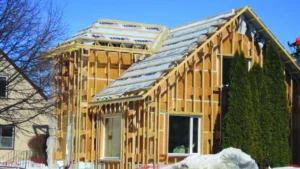
Phase 2: Envelope-First Strategy Prioritizing the building “jacket” before mechanical systems:
- Airtightness Layer Installation: Continuous intelligent membranes (vapor-variable or vapor-closed depending on climate and assembly) with precision sealing of service penetrations
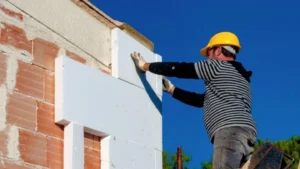
- Thermal Bridge Mitigation: Exterior insulation strategies that wrap structural elements, eliminating cold bridges that cause condensation and mold
- Advanced Glazing: Triple-pane or vacuum-insulated glazing with thermally broken frames
Phase 3: Systems Integration Rightsized mechanical systems—typically air-source or geothermal heat pumps—paired with heat recovery ventilation. Smart building controls with predictive algorithms optimize performance based on occupancy patterns and weather forecasting.
Phase 4: Verification & Monitoring Post-occupancy monitoring ensures predicted savings materialize. ECMC provides measurement and verification (M&V) protocols compliant with IPMVP (International Performance Measurement and Verification Protocol) standards.
Retrofitting as Strategic Risk Management
As climate regulations tighten and energy costs escalate, unretrofitted buildings face stranded asset risk—premature obsolescence due to inability to meet energy codes or tenant expectations. The EU’s Energy Performance of Buildings Directive (EPBD) and similar mandates globally are systematically devaluing inefficient stock.
Conversely, deep-retrofitted buildings offer resilience arbitrage. During extreme heat events or grid stress, high-performance envelopes maintain habitable temperatures without active cooling. During energy price spikes, minimal demand buffers operational costs. In carbon-constrained markets, zero-carbon retrofitted assets attract premium tenants and green financing.
The Social Responsibility Dimension
Retrofitting extends beyond individual asset optimization to community-scale impact. By improving existing housing stock and commercial buildings, ECMC contributes to:
- Energy equity: Reducing energy burden for low-income households through efficiency
- Urban heat island mitigation: Cool roofs and reduced HVAC waste heat lower ambient temperatures
- Grid stability: Peak demand reduction delays costly infrastructure upgrades, benefiting all ratepayers
Organizations that retrofit demonstrate stakeholder capitalism in action—delivering returns to investors while serving broader environmental and social objectives.
Conclusion: The Retrofit-First Future
The construction industry has reached an inflection point. The greenest building is no longer the newest high-tech tower—it’s the existing building transformed through deep energy retrofitting into a high-performance, low-carbon asset.
ECMC partners with building owners, developers, and portfolio managers to execute these transformations with technical rigor and financial precision. Whether your objective is carbon neutrality compliance, asset value maximization, or occupant health optimization, deep retrofitting offers the most expedient pathway.
The buildings we retrofit today will define our carbon trajectory for the next fifty years. Let’s ensure they perform to their potential.
Ready to assess your portfolio’s retrofit potential? Contact ECMC to schedule a building forensics assessment and discover your pathway to high-performance existing assets.