

Al Sa'fat Energy Modelling
By Qasim Virk 5 min read

Every new building in Dubai has to meet Al Sa'fat, the emirate's green building system. For most projects, the energy section is where compliance is won or lost, and where design teams face a choice: follow the prescriptive rules item by item, or prove compliance through energy modelling.
Choosing the right route early can save redesigns, approval delays and money. This guide explains how energy modelling works under Al Sa'fat and when it's the smarter option.
Quick answer: Al Sa'fat offers two ways to show energy compliance. The elemental method requires the building to meet each energy requirement individually, such as envelope, glazing and equipment efficiency. The performance method uses energy modelling, such as dynamic thermal simulation, to compare the proposed building with a reference building of the same shape, size and operating pattern that meets all elemental requirements. The building complies if its predicted annual energy use is equal to or lower than the reference building's. The comparison follows ASHRAE 90.1 Appendix G, except where Al Sa'fat sets its own values.
What is Al Sa'fat?
Al Sa'fat is Dubai's green building evaluation system, administered by Dubai Municipality. It sets sustainability requirements for new buildings across energy, water, materials, indoor environment and site planning.
It has three levels:
Level | What it means |
|---|---|
Silver Sa'fa | The baseline. Its requirements apply to all new buildings, with some items optional for villas and industrial buildings |
Golden Sa'fa | All Silver requirements plus additional items, such as air leakage testing regardless of building size |
Platinum Sa'fa | All Silver and Golden requirements plus further items |
Silver is mandatory. Golden and Platinum are higher levels that some developers pursue, and Golden is often expected for certain government and prestige projects. Check the latest Dubai Municipality requirements for your building type.
Two compliance routes: elemental vs performance method
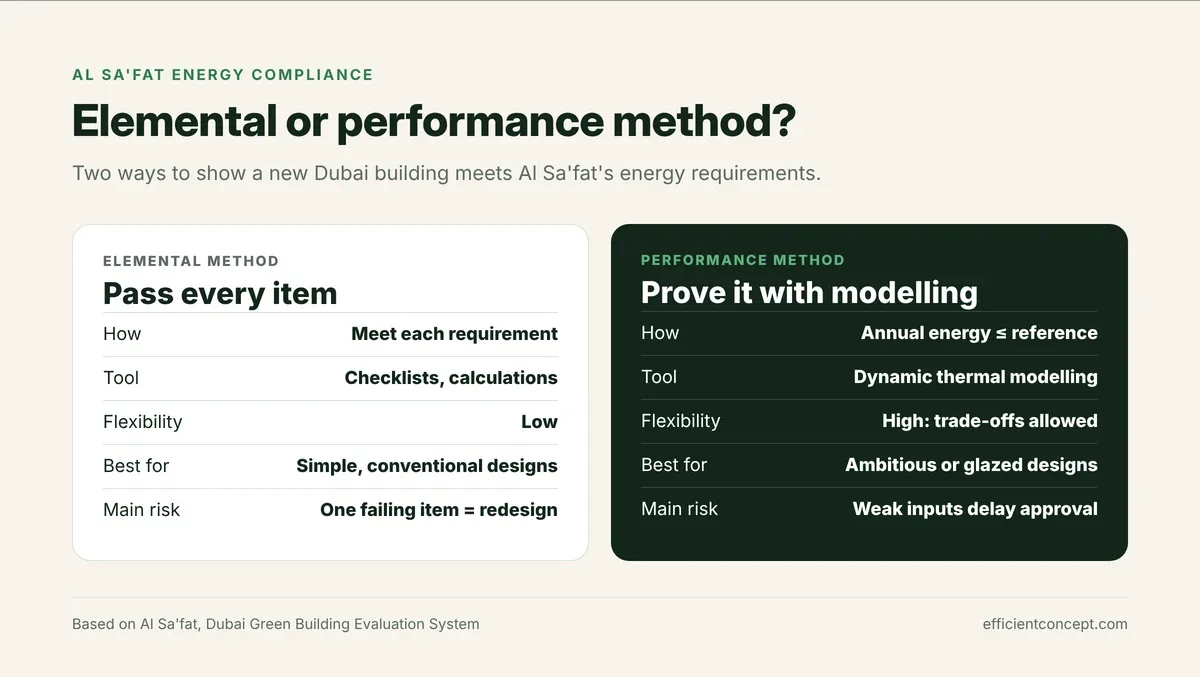
Elemental method | Performance method | |
|---|---|---|
How it works | Meet each energy requirement individually | Show whole-building annual energy use is no higher than a reference building |
Tool | Checklists and calculations | Energy modelling (dynamic thermal simulation) |
Flexibility | Low: every item must pass | High: strengths in one area can offset another |
Best for | Simple, conventional buildings that already meet every item | Architecturally ambitious designs, large glazing, unusual geometry, or projects that miss one or two elemental items |
Main risk | A single failing item forces redesign | Poor modelling inputs cause rejections or delays |
The performance method's big advantage is trade-offs. Say a tower's design calls for more glazing than the elemental limit allows. Under the elemental method, that's a fail. Under the performance method, the design team can compensate, for example with higher-performance glass, better shading, more efficient chillers or improved lighting, as long as the whole building uses no more energy than the reference.
How Al Sa'fat energy modelling works
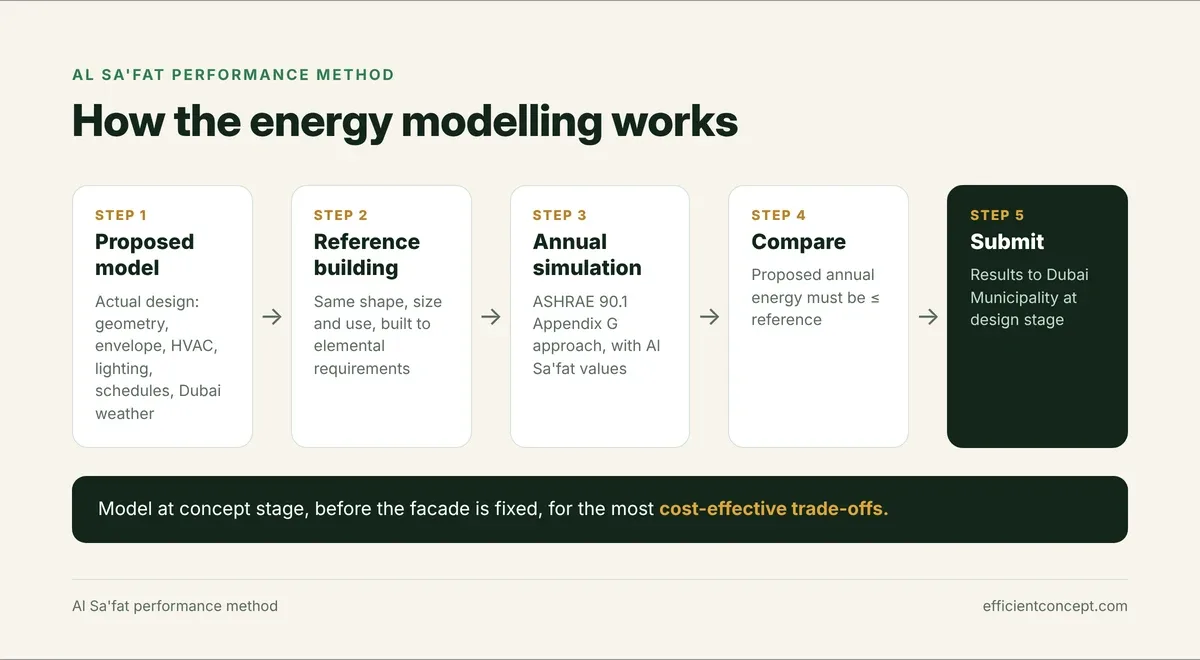
Five-step Al Sa'fat energy modelling process: build the proposed model, create the reference building, run annual simulations, compare results and submit to Dubai Municipality
Build the proposed building model. Enter the actual design: geometry, orientation, envelope, glazing, shading, HVAC, lighting, occupancy schedules and Dubai weather data.
Create the reference building. Same shape, size and operating patterns as the proposed design, but with every elemental Al Sa'fat requirement met exactly.
Run annual simulations. Both models are simulated hour by hour across a full year using the ASHRAE 90.1 Appendix G approach, with Al Sa'fat's own values where it sets them.
Compare the results. The proposed building passes if its annual energy consumption is equal to or lower than the reference building's.
Submit the results. Energy modelling results are submitted to Dubai Municipality at the design stage, along with other required documents such as heat load calculations.
An example
An illustrative 30-storey residential tower in Dubai Marina has a design with floor-to-ceiling glazing on its sea-facing elevations.
Elemental check: the glazing ratio on two elevations exceeds the elemental limit, so the building fails that route.
Performance route: the energy model tests combinations of better glass, external fins on the west facade, higher-efficiency chillers and LED lighting with controls.
Result: one package brings predicted annual energy use below the reference building, so the design complies without losing its signature glazing.
This example is illustrative. Results depend on the specific design.
Energy modelling at the concept stage, before the facade is fixed, gives the most room for cost-effective trade-offs. To understand how modelling differs from auditing an existing building, read our guide on energy modelling vs energy audit.
Common mistakes that delay approval
Starting modelling too late. Once the facade and MEP design are fixed, there's little room for trade-offs.
Reference building errors. The reference must match the proposed building's shape, size and operating patterns, with elemental values applied correctly.
Unrealistic inputs. Overly optimistic schedules, equipment efficiencies or lighting densities can be challenged.
Inconsistent documents. Model inputs must match the drawings and specifications submitted.
Treating compliance as performance. A compliant model shows the design meets the standard. It doesn't guarantee future energy bills, so commissioning and good operation still matter.
Frequently asked questions
What is Al Sa'fat?
Al Sa'fat is Dubai's green building evaluation system, administered by Dubai Municipality. It sets sustainability requirements for new buildings, with three levels: Silver (the mandatory baseline), Golden and Platinum.
What is the performance method in Al Sa'fat?
The performance method is an alternative way to show energy compliance. It uses energy modelling to show that the proposed building's annual energy use is equal to or lower than a reference building that meets all elemental requirements.
Which ASHRAE standard does Al Sa'fat energy modelling use?
The Al Sa'fat performance method follows the ASHRAE 90.1 Appendix G methodology, except where Al Sa'fat sets its own minimum values for envelope, equipment efficiency and other parameters.
Is energy modelling mandatory under Al Sa'fat?
No. Energy modelling is required only if a project chooses the performance method. Buildings that meet every elemental energy requirement can comply without it.
When should I use the performance method?
Use it when a design doesn't meet one or more elemental requirements, such as a high glazing ratio, or when you want flexibility to trade off envelope, HVAC and lighting performance.
What is a reference building?
A reference building is a model with the same shape, size and operating patterns as the proposed building, but built to the elemental Al Sa'fat requirements. The proposed design is compared against it.
Final thoughts: model early, approve faster
Al Sa'fat's performance method gives Dubai design teams real freedom, but only if the energy model is built early and built well. Done right, it protects design intent, avoids late redesigns and often finds cost-effective efficiency gains along the way.
At Efficient Concept, our energy modelling team supports developers, architects and MEP consultants with Al Sa'fat performance-method modelling, design optimisation and compliance documentation.
Working on a Dubai project? Book a free initial consultation with our team, or call +971 52 710 0320, to discuss the best compliance route for your design.