I-RECs in the UAE
By Osman Masood 6 min read
When a UAE company says its operations run on "100% renewable electricity", the electricity coming out of its sockets is almost certainly the same grid mix as everyone else's. What makes the claim credible is a certificate: proof that an equal amount of renewable or clean electricity was generated and fed into the grid on its behalf.
In the UAE, that certificate is the I-REC. And the market for it is booming.
Quick answer: An I-REC (International Renewable Energy Certificate) is proof that 1 MWh of electricity was generated from a renewable or clean source. In the UAE, certificates are issued in Abu Dhabi as Clean Energy Certificates through EWEC, and in Dubai through DEWA. Companies buy I-RECs and redeem them in their name to claim the clean attributes of their electricity, which lowers their market-based Scope 2 emissions under the GHG Protocol. Abu Dhabi certificates must generally be used for consumption within Abu Dhabi.
What is an I-REC?
An I-REC is an energy attribute certificate issued under the I-REC Standard. Each certificate represents one megawatt-hour (MWh) of electricity from a specific registered power plant, and records where, when and how it was produced.
The key idea is that the electricity and its "green" attribute can be separated. Once renewable electricity enters the grid, it mixes with everything else. The certificate carries the clean attribute separately, so it can be bought, transferred and finally redeemed (retired) on behalf of the company claiming it. Once redeemed, it can't be sold or used again.
Why the UAE I-REC market is growing so fast
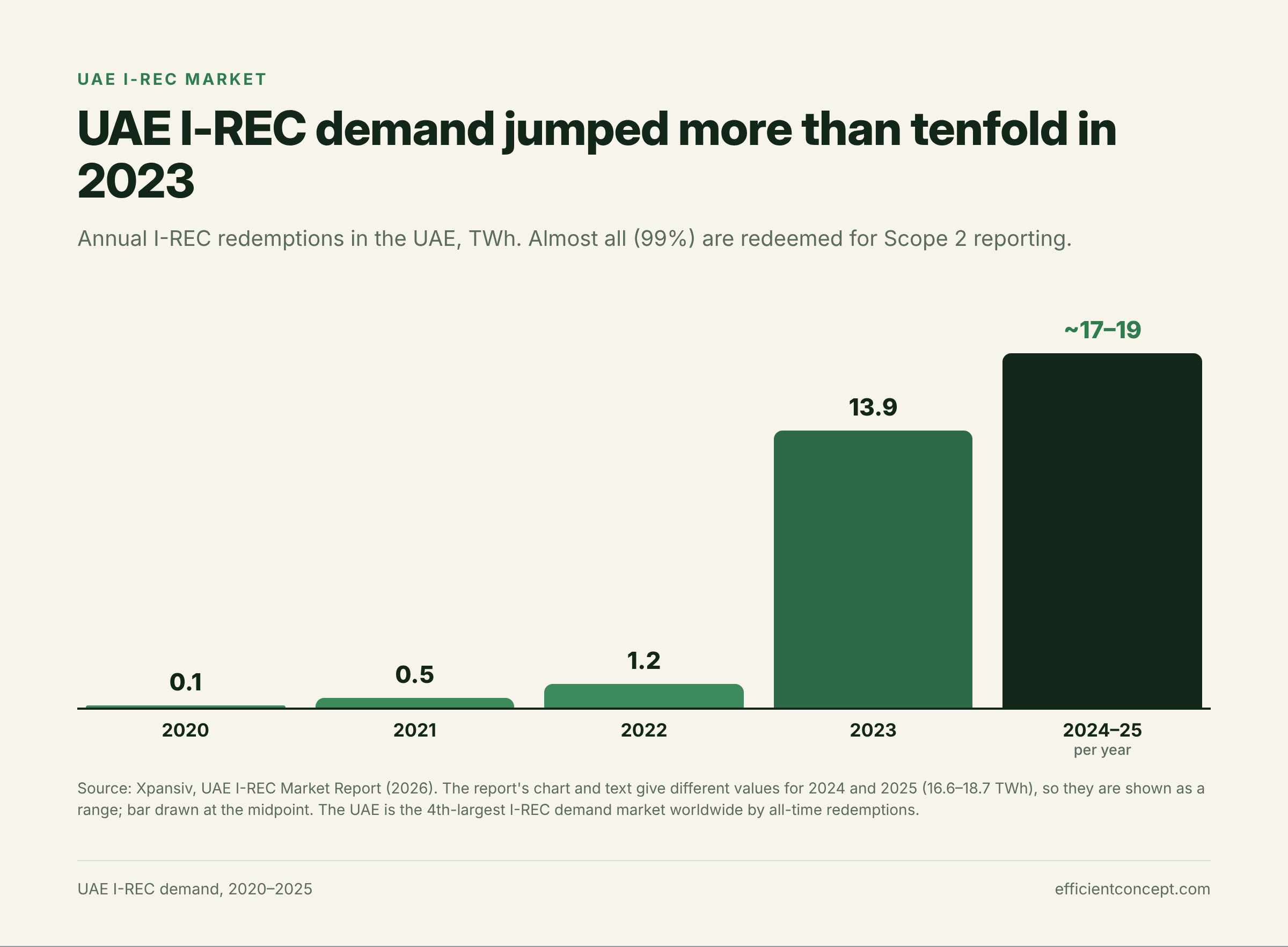
Chart showing UAE I-REC demand growing from about 1.2 TWh in 2022 to roughly 14–19 TWh a year from 2023 onwards
The numbers are striking. According to market data from Xpansiv, UAE I-REC demand grew from about 1.2 TWh in 2022 to roughly 14–19 TWh a year from 2023 onwards, making the UAE the leading I-REC market in the Middle East and the fourth-largest demand market in the world by all-time redemptions. Almost all of it (99%) is redeemed for Scope 2 reporting.
Three things are driving that growth:
Huge clean supply. The UAE has some of the world's largest solar plants, including Noor Abu Dhabi, Al Dhafra and the Mohammed bin Rashid Al Maktoum Solar Park, plus the Barakah nuclear plant.
Corporate climate targets. Companies with net-zero, RE100 or science-based targets need credible ways to cut Scope 2.
Regulation and export markets. The UAE climate law requires emissions reporting, and international customers increasingly ask suppliers for low-carbon evidence.
The market is also becoming more transparent. S&P Global Platts began a daily UAE I-REC price assessment in November 2026.
How the I-REC system works in the UAE
The UAE has two main certificate systems, both following the I-REC Standard and recorded in the same international registry.
Abu Dhabi | Dubai | |
|---|---|---|
Certificate name | Clean Energy Certificates (CECs) | I-RECs |
Who issues | Abu Dhabi Department of Energy | World Green Economy Organization (WGEO) |
Who sells | EWEC, the single registrant in the emirate | DEWA |
How they're sold | Auctions | Auctions |
Main sources | Barakah nuclear, Noor Abu Dhabi and Al Dhafra solar | Mohammed bin Rashid Al Maktoum Solar Park |
Key rule | Certificates issued in Abu Dhabi must be used for consumption within Abu Dhabi | Check current DEWA terms for eligibility |
Two practical points follow. First, match certificates to where you consume electricity. A company with operations in both emirates may need certificates from both systems. Second, note the technology: Abu Dhabi supply includes nuclear as well as solar. Nuclear is zero-carbon, but some corporate programmes, such as RE100, only count renewable sources. Check which technology your reporting framework accepts.
How to buy and redeem I-RECs: step by step
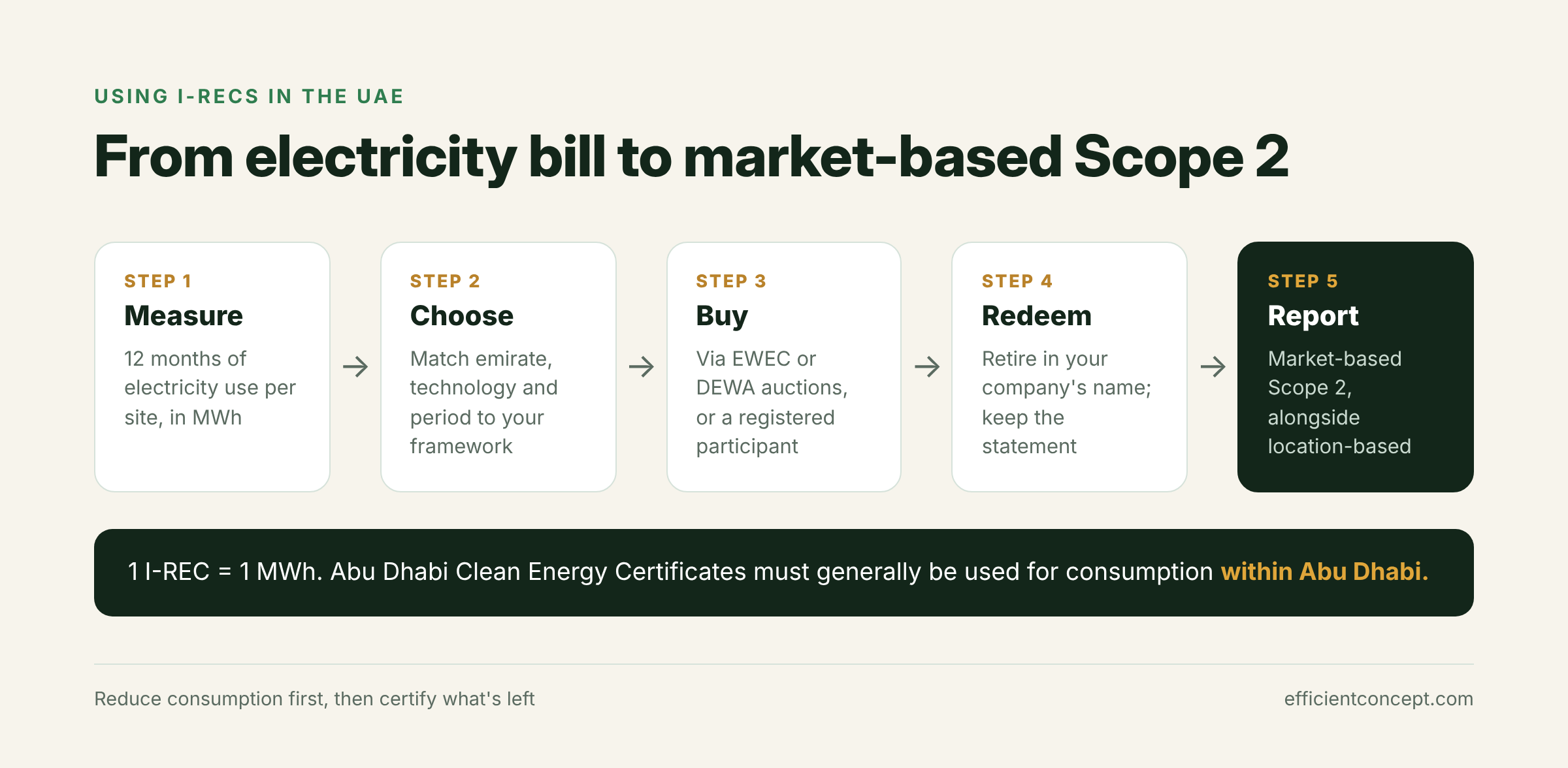
Five-step process for using I-RECs in the UAE: measure electricity use, choose certificates, buy, redeem in your name and report market-based Scope 2
Measure your electricity use. Gather 12 months of consumption for every site and account, in MWh. You'll need one certificate per MWh you want to cover.
Decide your goal. Do you want to cover 100% of electricity, a share of it, or specific sites? Which framework are you reporting to (GHG Protocol, RE100, CDP, a customer requirement)?
Choose the right certificates. Match the location (emirate), technology (solar, nuclear) and vintage (the generation period) to your consumption and your framework's rules.
Buy through the right channel. Buy at auction, or through a registered I-REC participant or advisor who holds a registry account.
Redeem in your company's name. Certificates must be redeemed (retired) for your organisation, for the reporting period they cover. Keep the redemption statement as evidence.
Report market-based Scope 2. Apply zero emissions to the covered MWh in your market-based Scope 2 figure, and continue reporting location-based Scope 2 alongside it.
A worked example
An illustrative Dubai company uses 4,000 MWh of electricity a year across two offices and a warehouse.
Location-based Scope 2 (at an illustrative 0.4 kg CO2e per kWh): about 1,600 tCO2e.
The company buys and redeems 4,000 I-RECs from Dubai solar generation, for the same reporting year.
Market-based Scope 2: reported as close to zero for that electricity, while location-based stays at about 1,600 tCO2e.
Figures are illustrative. Use the emission factors and rules that apply to your reporting.
The smart order is to reduce first, then certify. If an energy audit cuts that company's consumption by 20%, it only needs 3,200 certificates instead of 4,000, and it saves on its electricity bill every year as well.
Common mistakes
Buying certificates without redeeming them. Holding I-RECs in a trade account doesn't count. They must be redeemed in your name.
Mismatching location. Abu Dhabi certificates generally can't be used for consumption outside Abu Dhabi.
Mismatching the reporting period. Use certificates whose generation period matches the year you're reporting on, in line with your framework.
Assuming every framework accepts nuclear. Check the rules of RE100 or your customer's programme.
Reporting only market-based Scope 2. The GHG Protocol asks for both location-based and market-based figures.
Using certificates instead of efficiency. Certificates change how electricity is accounted for. They don't reduce your bill or your consumption.
Frequently asked questions
What is an I-REC?
An I-REC (International Renewable Energy Certificate) is a certificate issued under the I-REC Standard that proves 1 MWh of electricity was generated from a specific renewable or clean energy source. Companies redeem I-RECs to claim the clean attributes of the electricity they use.
How do I buy I-RECs in the UAE?
In Abu Dhabi, Clean Energy Certificates are sold by EWEC, and in Dubai, I-RECs are sold by DEWA, both mainly through auctions. Companies can also buy through registered I-REC participants or advisors who hold registry accounts and redeem certificates on their behalf.
What are Clean Energy Certificates in Abu Dhabi?
Clean Energy Certificates (CECs) are Abu Dhabi's energy attribute certificates. They follow the I-REC Standard, are issued under the Department of Energy's regulatory policy, and are sold by EWEC. They must generally be used for electricity consumed within Abu Dhabi.
Do I-RECs reduce Scope 2 emissions?
Yes, redeemed I-RECs reduce market-based Scope 2 emissions for the electricity they cover. Location-based Scope 2, which reflects the grid average, does not change.
How many I-RECs do I need?
One I-REC covers 1 MWh of electricity. To cover 100% of your consumption, you need as many certificates as the MWh you use in the reporting period.
Are I-RECs the same as carbon credits?
No. I-RECs are about the source of the electricity you use and affect Scope 2 accounting. Carbon credits represent emissions reduced or removed elsewhere and are used to offset emissions. They're not interchangeable.
Final thoughts: certify what you can't yet cut
I-RECs are the recognised way for UAE companies to back renewable electricity claims and lower their market-based Scope 2 emissions. Used well, after efficiency and alongside honest reporting, they're a credible part of a decarbonisation plan.
At Efficient Concept (ECMC), our I-REC services help UAE organisations work out how many certificates they need, source the right ones for their location and framework, and handle redemption and documentation. We also help cut consumption first through energy audits.
Ready to back your renewable energy claims? Book a free initial consultation with our Dubai team, or call +971 52 710 0320.