
What Are Scope 1, 2 and 3 Emissions?
By Komal Kazmi 6 min read

If your company has been asked for its "carbon footprint" by a bank, a customer or a regulator, you'll quickly run into three terms: Scope 1, Scope 2 and Scope 3. They come from the GHG Protocol, the world's most widely used standard for measuring greenhouse gas emissions, and they're how almost every emissions report is organised, including reporting under the UAE climate law.
This guide explains each scope in plain language, with examples from typical UAE businesses.
Quick answer: Scope 1 emissions are direct emissions from sources your company owns or controls, such as generator diesel, company vehicles and refrigerant leaks. Scope 2 emissions are indirect emissions from the electricity, cooling, heat or steam you buy. Scope 3 emissions are all other indirect emissions in your value chain, such as purchased goods, business travel, employee commuting, waste and the use of the products you sell. For most UAE offices and commercial buildings, Scope 2 (electricity and cooling) is the largest of the first two, while Scope 3 is often the largest overall.
The three scopes explained
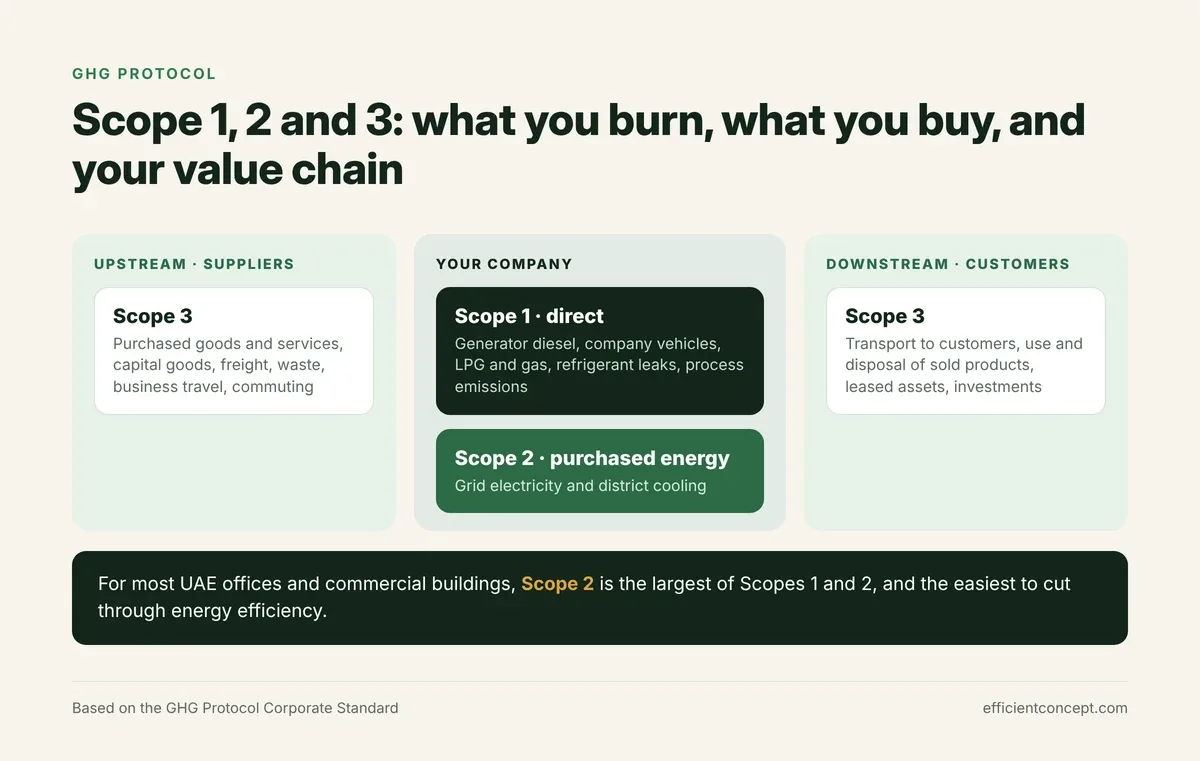
Diagram of Scope 1, Scope 2 and Scope 3 emissions across a company's value chain, with upstream suppliers, the company's own operations and downstream customers
Scope 1: Direct emissions
Scope 1 covers greenhouse gases released directly from sources your organisation owns or controls. In the UAE, that usually means:
diesel burned in backup generators
petrol and diesel in company-owned vehicles and fleets
natural gas or LPG used in kitchens, boilers or industrial processes
refrigerant leaks from chillers, split units and cold rooms
process emissions from industrial activities, such as cement or chemical production
Scope 2: Indirect emissions from purchased energy
Scope 2 covers emissions from generating the electricity, steam, heat or cooling you buy. The emissions happen at the power plant or cooling plant, but they're counted in your inventory because your demand causes them.
In the UAE, Scope 2 usually means grid electricity from DEWA, EtihadWE, ADDC/AADC or SEWA, plus district cooling, which is common in Dubai and Abu Dhabi developments.
Scope 3: Other indirect emissions in your value chain
Scope 3 covers all other emissions linked to your business that happen outside your direct control, both upstream (suppliers) and downstream (customers). For many companies, Scope 3 is the biggest part of the footprint, but also the hardest to measure.
Scope 1, 2 and 3 examples for UAE businesses
Business type | Scope 1 | Scope 2 | Scope 3 (examples) |
|---|---|---|---|
Office-based company | Refrigerant leaks, backup generator | Office electricity, district cooling | Business travel, commuting, purchased IT and services |
Shopping mall | Generators, refrigerants, maintenance vehicles | Electricity and chilled water for common areas | Tenant energy use (if not controlled), waste, construction materials |
Hotel | Kitchen LPG, generators, laundry boilers, refrigerants | Electricity, district cooling | Food and beverage supply chain, guest travel, waste |
Manufacturer | Fuel in furnaces and boilers, process emissions, forklifts | Factory electricity | Raw materials, freight, use and disposal of sold products |
Logistics company | Truck and van fleet fuel | Warehouse electricity and cooling | Subcontracted transport, packaging, fuel supply chain |
Two ways to report Scope 2: location-based and market-based
The GHG Protocol asks companies to report Scope 2 in two ways:
Location-based: uses the average emission factor of the grid where you consume electricity. It reflects the physical grid mix.
Market-based: reflects the electricity you've chosen to buy through contracts and certificates. If you buy renewable energy certificates, such as I-RECs, you can report lower market-based Scope 2 emissions for the electricity they cover.
This is why renewable energy claims need proper certificates. Without them, you can't credibly reduce market-based Scope 2.
The 15 categories of Scope 3
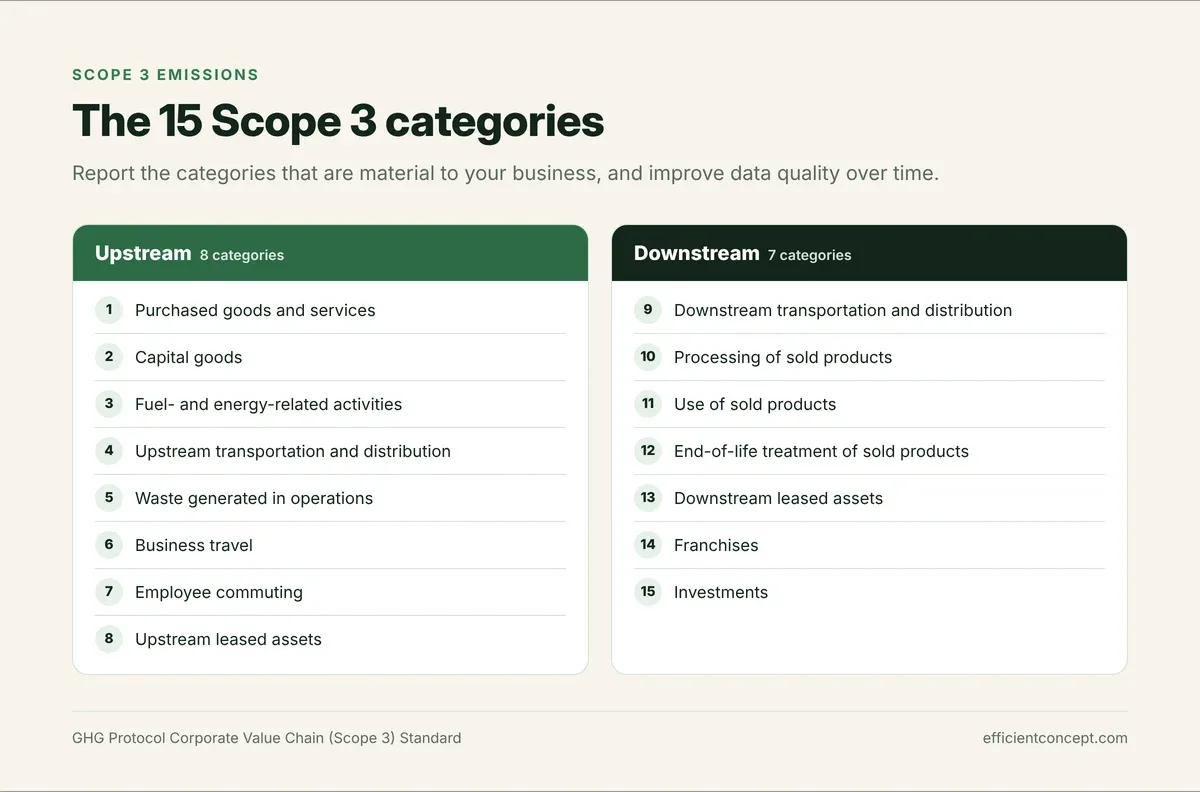
The 15 Scope 3 emissions categories of the GHG Protocol, divided into 8 upstream and 7 downstream categories
The GHG Protocol groups Scope 3 into 15 categories.
Upstream (8):
Purchased goods and services
Capital goods
Fuel- and energy-related activities not in Scope 1 or 2
Upstream transportation and distribution
Waste generated in operations
Business travel
Employee commuting
Upstream leased assets
Downstream (7):
Downstream transportation and distribution
Processing of sold products
Use of sold products
End-of-life treatment of sold products
Downstream leased assets
Franchises
Investments
You don't need to report all 15. Start with the categories that are material to your business. For an office company, that's usually purchased goods, business travel and commuting. For a landlord, it's often tenant energy use (downstream leased assets).
How to calculate Scope 1 and Scope 2
The basic formula is the same for every source:
Emissions (tCO2e) = Activity data × Emission factor
For example, an illustrative Dubai office using 1,500,000 kWh of grid electricity a year, at an illustrative factor of 0.4 kg CO2e per kWh, has location-based Scope 2 emissions of about 600 tCO2e.
The emission factor is for illustration only. Use the factors specified by MOCCAE's reporting tool, your utility or your verifier.
The hard part isn't the maths. It's getting complete, accurate activity data: every electricity and district cooling account, every generator fuel record and every refrigerant top-up. That's where an energy audit helps, by reconciling meters and bills into a baseline you can trust.
Common mistakes
Forgetting refrigerants. Leaks from chillers and AC units are Scope 1, and some refrigerants have global warming potentials thousands of times higher than CO2.
Missing district cooling. Chilled water is purchased energy, so it belongs in Scope 2, not left out because it isn't on the electricity bill.
Double counting. Tenant electricity counted by both landlord and tenant, or company vehicles counted as both Scope 1 and business travel.
Claiming renewable electricity without certificates. Market-based Scope 2 reductions need proper evidence, such as I-RECs.
Trying to measure all of Scope 3 at once. Start with the material categories and improve data quality over time.
Frequently asked questions
What is the difference between Scope 1, 2 and 3 emissions?
Scope 1 emissions come directly from sources a company owns or controls. Scope 2 emissions come from the electricity, heat, steam or cooling it buys. Scope 3 emissions are all other indirect emissions in its value chain, from suppliers to customers.
Is electricity Scope 1 or Scope 2?
Purchased electricity is Scope 2. If a company generates its own electricity by burning fuel, for example in a diesel generator, the emissions from that fuel are Scope 1.
Is district cooling Scope 2?
Yes. Purchased cooling, including chilled water from district cooling providers, is counted as Scope 2.
Are refrigerant leaks Scope 1?
Yes. Refrigerant leaks from equipment a company owns or controls, such as chillers and air conditioners, are Scope 1 emissions.
What are the 15 categories of Scope 3 emissions?
The GHG Protocol defines 8 upstream categories (such as purchased goods and services, business travel and employee commuting) and 7 downstream categories (such as use of sold products, end-of-life treatment and investments).
Do UAE companies have to report Scope 3?
The UAE climate law focuses mainly on Scope 1 and Scope 2, and Scope 3 is not a confirmed general requirement today. However, banks, investors and international customers increasingly ask for material Scope 3 data.
Final thoughts: start with what you control
Scope 1, 2 and 3 can sound complicated, but the logic is simple: what you burn, what you buy, and what happens in your value chain. For most UAE businesses, the best place to start is Scopes 1 and 2, because the data already exists in your bills and fuel records, and because energy efficiency is the fastest way to reduce them.
At Efficient Concept (ECMC), we help UAE organisations build reliable Scope 1 and 2 baselines through energy audits, find practical ways to reduce them, and back renewable electricity claims with I-REC services.
Need help measuring your emissions? Book a free initial consultation with our Dubai team, or call +971 52 710 0320.