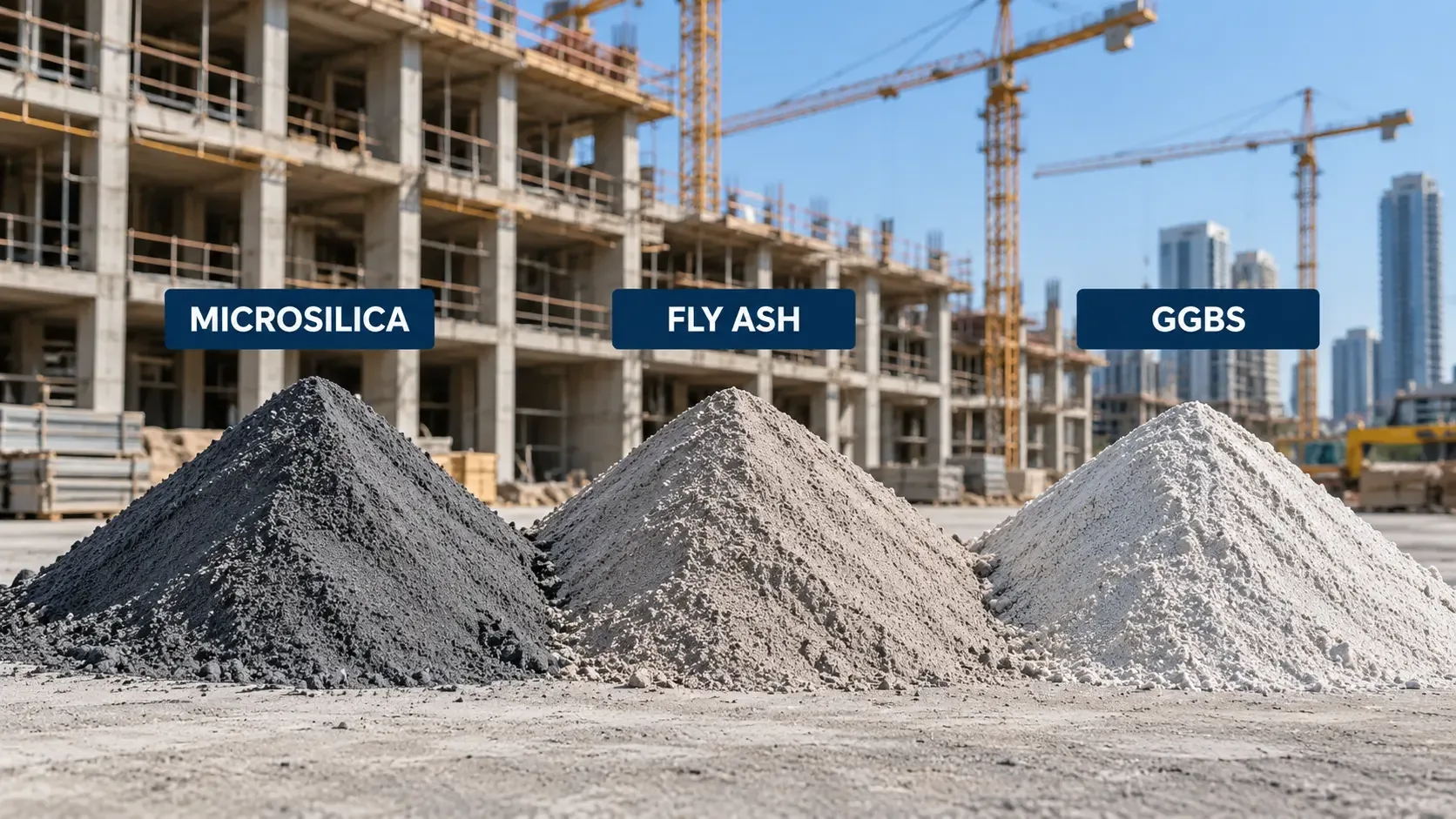

Microsilica Dosage for Marine and Coastal Concrete
By Murtaza Mustafa 6 min read

The UAE coastline is one of the toughest places in the world for concrete. High temperatures, salty seawater, chloride-laden air and saline groundwater all work together to attack reinforced structures. For ports, jetties, seawalls, waterfront towers and coastal infrastructure, durability isn't a bonus. It's the whole design challenge.
Microsilica (silica fume) is one of the most effective tools engineers have against that attack. But how much should you add? Too little and you lose the benefit. Too much and you create workability and cracking problems.
Quick answer: Microsilica is typically added at 5–10% by weight of cement (or total binder), with up to about 15% for special high-performance applications. For marine and coastal concrete, dosages toward the middle or upper part of the usual range are common, usually combined with GGBS or fly ash, a low water-binder ratio and a superplasticiser. The exact dosage should always be confirmed by mix design and trial batches using your project's materials, as manufacturers recommend.
Why coastal concrete fails
Most marine concrete doesn't fail because it's too weak. It fails because chlorides reach the steel reinforcement.
Chloride ions from seawater or salt-laden air penetrate the concrete through its pore network.
When enough chloride reaches the reinforcement, it breaks down the steel's protective layer.
The steel corrodes and expands, cracking and spalling the concrete cover.
Cracks let in more chlorides, and the damage accelerates.
In the Gulf, heat speeds up both chloride transport and corrosion, while sulphates in soil and groundwater add a second line of attack.
How microsilica protects marine concrete
Microsilica works in two ways:
Filling. Its ultra-fine particles, around 100 times smaller than cement grains, pack the spaces between cement particles.
Reacting. Its amorphous silica reacts with calcium hydroxide to form extra binding gel, refining the pore structure and densifying the weak zone around aggregates.
The result is concrete with fewer connected pores, much lower permeability and higher electrical resistivity, all of which slow chloride penetration and corrosion. That's why many high-rise buildings and high-performance structures in the Gulf have used microsilica concrete. For a comparison with other additives, see our guide to microsilica vs fly ash vs GGBS.
How much microsilica to use
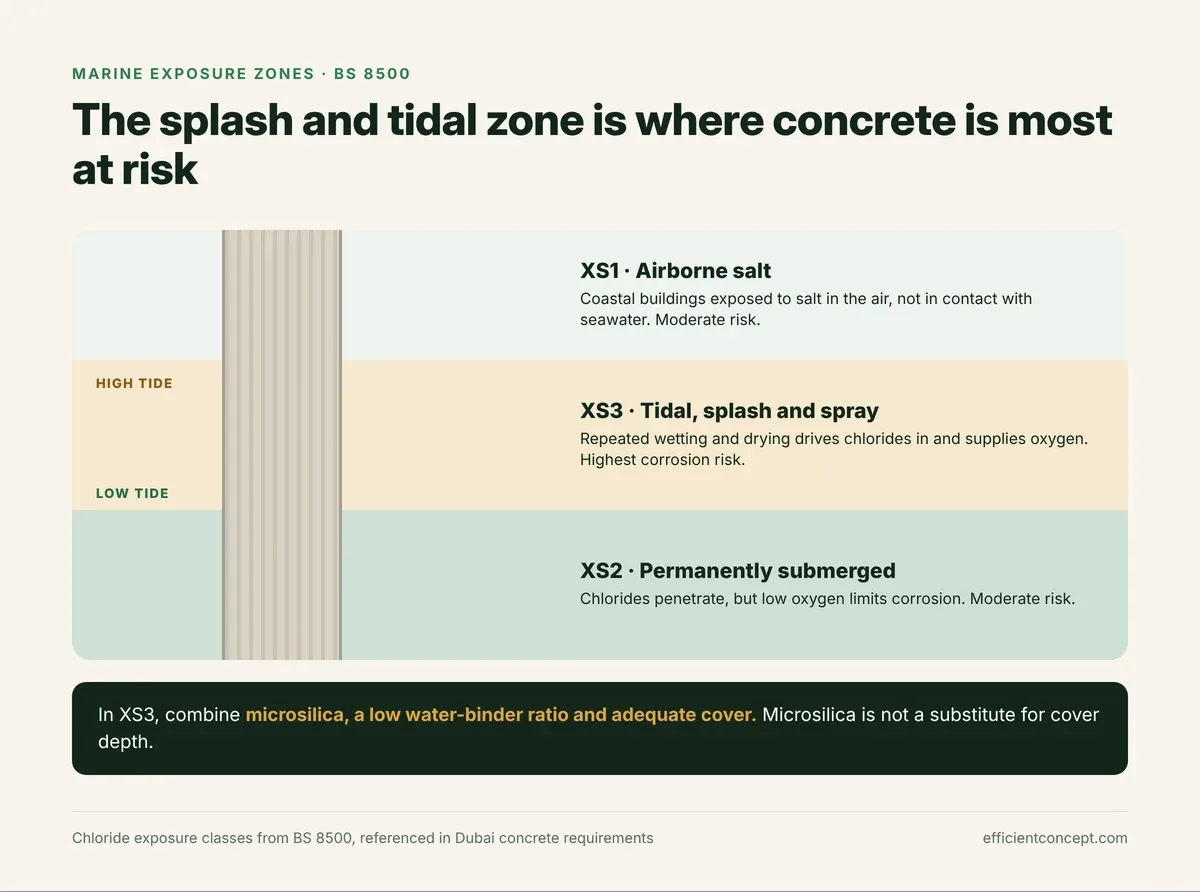
Microsilica dosage guide showing typical percentages by weight of cement for general high-performance concrete, marine and coastal structures and special applications
Application | Typical microsilica dosage* | Notes |
|---|---|---|
General high-performance concrete | About 5–8% | Improves strength and reduces permeability |
Marine, coastal and splash-zone structures | About 7–10% | Often with GGBS or fly ash in a ternary blend |
Special high-strength or very low-permeability concrete | Up to about 15% | Needs careful handling, high-range water reducer and curing |
*Typical industry ranges by weight of cement or total binder. Manufacturers commonly recommend 5–10%. Always confirm with mix design and trial batches.
Above the typical range, returns diminish while problems grow: stickier mixes, higher water demand, more risk of plastic shrinkage cracking and higher cost. More isn't automatically better.
A worked example
An illustrative marine mix has a total binder content of 420 kg/m³, with a target of 8% microsilica and 40% GGBS by weight of binder.
Component | Calculation | Quantity per m³ |
|---|---|---|
Microsilica | 420 × 8% | about 34 kg |
GGBS | 420 × 40% | 168 kg |
Portland cement | 420 − 34 − 168 | about 218 kg |
Water (water-binder ratio 0.38) | 420 × 0.38 | about 160 litres |
For a 500 m³ pour, that's about 17 tonnes of microsilica, or roughly 680 bags of 25 kg.
This example is illustrative only and is not a mix design. Proportions must be designed and verified for your project's cement, aggregates, admixtures and exposure class.
Match the mix to the exposure zone
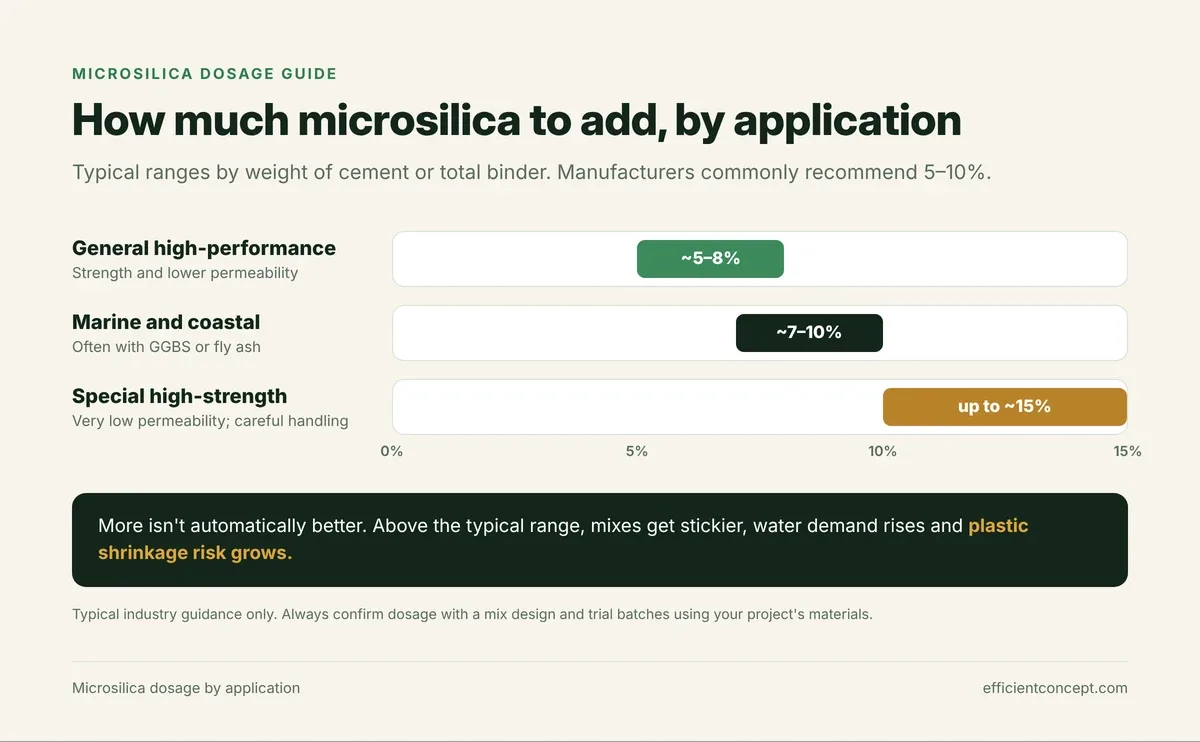
Marine concrete exposure zones showing airborne salt, splash and tidal zone and submerged zone, with the tidal and splash zone as the most aggressive for reinforcement corrosion
Dubai's concrete requirements reference BS 8500, which classifies chloride exposure from seawater into three classes:
Exposure class | Where | Risk |
|---|---|---|
XS1 | Exposed to airborne salt, but not in contact with seawater (e.g. coastal buildings) | Moderate |
XS2 | Permanently submerged | Moderate: chlorides penetrate but little oxygen limits corrosion |
XS3 | Tidal, splash and spray zones | Highest: repeated wetting and drying drives chlorides in and supplies oxygen |
The tidal and splash zone is where microsilica, low water-binder ratios and adequate cover matter most. Microsilica is not a substitute for cover depth. Both work together.
Mixing and curing: where good dosages go wrong
Mixing
Add microsilica with the cement and aggregates, before water, so it disperses evenly. Manufacturer guidance for some products suggests about 30 seconds of dry mixing per m³, then at least 90 seconds after water is added.
Always use a superplasticiser. Microsilica increases water demand, and adding water on site defeats the purpose.
Microsilica concrete is thixotropic. It can look stiff at rest but flows well when vibrated, so a flow test can be more representative than slump alone.
Curing
Microsilica concrete bleeds very little, so its surface dries fast, and in UAE heat and wind that can cause plastic shrinkage cracking within hours.
Protect the surface immediately after placing, with evaporation retarders, wet hessian or curing compounds.
Keep the concrete continuously moist for an extended period, especially where GGBS is also used.
Avoid placing in the hottest part of the day, and cool the concrete where needed.
Common mistakes
Using microsilica to make up for poor cover. Reduced cover lets chlorides reach steel faster, whatever the mix.
Adding water on site. It destroys the low permeability you're paying for.
Late curing. Even an hour without protection in UAE summer conditions can cause surface cracking.
Ignoring trial batches. Local aggregates and cements vary, so dosage and admixtures must be proven with your materials.
Choosing on price per bag. Consistent quality, fineness and silica content matter more than a small saving on the material.
Frequently asked questions
What is the typical dosage of microsilica in concrete?
Microsilica is typically added at 5–10% by weight of cement or total binder. Some special high-performance applications use up to about 15%. The exact dosage should be confirmed by mix design and trial batches.
How much microsilica is used for marine concrete?
Marine and coastal concrete commonly uses microsilica toward the middle or upper end of the typical range, often around 7–10% of binder, usually together with GGBS or fly ash and a low water-binder ratio.
Is microsilica added by weight of cement or by replacement?
It can be specified either as an addition to the cement or as a partial replacement of it. Most mix designs express it as a percentage of total binder. Follow your project's mix design.
Why does microsilica concrete need a superplasticiser?
Microsilica's very fine particles increase water demand. A superplasticiser maintains workability without adding water, which keeps the water-binder ratio low and permeability low.
How should microsilica concrete be cured in hot weather?
Protect the surface immediately after placing to prevent plastic shrinkage cracking, using evaporation retarders, wet coverings or curing compounds, then keep the concrete continuously moist. Avoid placing in peak heat.
Can microsilica be used with GGBS?
Yes. Microsilica and GGBS are often combined in ternary blends for marine and coastal structures, combining low permeability and early strength with long-term durability.
Final thoughts: the right dose, done right
Microsilica can extend the life of coastal concrete significantly, but only when the dosage is right for the exposure and the concrete is mixed, placed and cured properly. Dosage, water-binder ratio, cover and curing are a package.
Efficient Concept supplies high-quality microsilica for marine, infrastructure and high-performance concrete projects across the UAE, with technical guidance on dosage and handling.
Planning a coastal or marine project? Contact our team or call +971 52 710 0320 for product data, pricing and technical advice.