

Energy Performance Contracts in Dubai
By Osman Masood 6 min read

Most building owners in Dubai know their chillers are ageing, their lighting is outdated and their BMS could do more. What often stops them is the same question: where does the capital come from?
An energy performance contract (EPC) answers that question by paying for the upgrade from the savings it creates. This guide explains how EPCs work in Dubai, the two main contract models and how to tell whether your building is a good candidate.
Quick answer: An energy performance contract is an agreement in which an energy services company (ESCO) designs and implements energy-saving upgrades in a building, and the savings pay for the project over an agreed term. In a shared savings model, the ESCO funds the upgrade and recovers its investment from a share of the savings, so the owner pays nothing upfront. In a guaranteed savings model, the owner funds the project (often with a loan), and the ESCO guarantees a minimum level of savings. In Dubai, ESCOs are accredited by the Regulatory and Supervisory Bureau, and Etihad ESCO, a DEWA subsidiary, leads the market. Savings are verified through a measurement and verification (M&V) process.
What is an energy performance contract?
An EPC shifts the performance risk of an efficiency project from the building owner to the ESCO. Instead of buying equipment and hoping it works, the owner contracts for an outcome: lower energy use, measured and verified.
A typical EPC includes:
an investment-grade energy audit to establish the baseline and identify measures
design, procurement and installation of the upgrades
often, operation and maintenance during the contract term
measurement and verification of savings, usually every year
a contractual commitment on savings, and remedies if they aren't achieved
The Dubai ESCO market
Dubai has one of the most developed EPC frameworks in the region:
Etihad ESCO, a subsidiary of DEWA, acts as a "super ESCO" that develops the market and works with private ESCOs.
ESCO accreditation is managed by Dubai's Regulatory and Supervisory Bureau, based on track record, staff expertise and financial strength.
Standard contract forms exist for both shared and guaranteed savings models, which reduces legal friction.
A clear policy push: Dubai's demand side management strategy targets major energy savings, with around 30,000 high-consuming buildings identified for retrofits.
The model is proven. In 2025, Etihad ESCO announced completion of Dubai's first energy savings performance contract, covering DEWA buildings. It reported savings of about 35.2 GWh of electricity and about 14,452 tonnes of CO2 through upgrades to HVAC, lighting, water systems and insulation.
Shared savings vs guaranteed savings
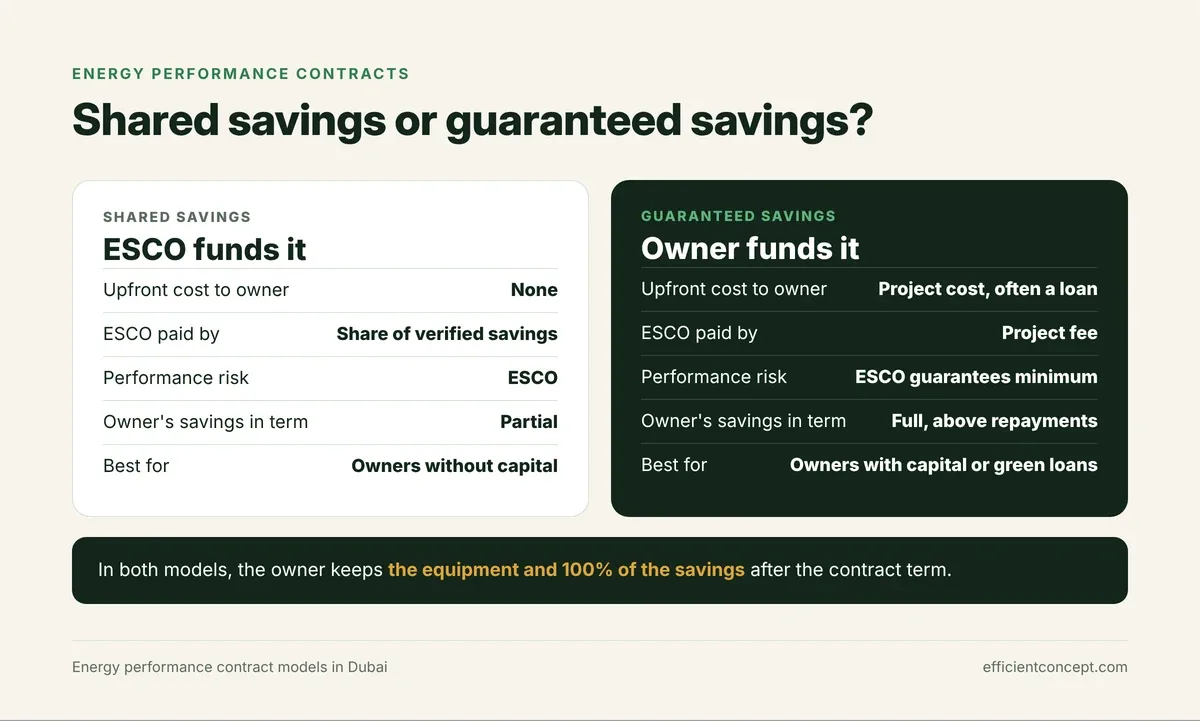
Comparison of shared savings and guaranteed savings energy performance contracts, showing who funds the project, who carries the risk and how savings are split
Shared savings | Guaranteed savings | |
|---|---|---|
Who funds the project | The ESCO | The building owner (own funds or a loan) |
Upfront cost to owner | None | Full project cost, usually financed |
How the ESCO is paid | A share of verified savings over the contract term | A fee for the project; savings cover the owner's loan repayments |
Who carries performance risk | The ESCO | The ESCO guarantees a minimum saving; it pays the shortfall if savings fall short |
Owner's share of savings during the term | Partial | Full (above loan repayments) |
Best for | Owners without capital or who want it off the balance sheet | Owners with access to capital or green loans who want to keep more of the savings |
After the contract term, the owner keeps all the savings and the upgraded equipment in both models. Green loans can make the guaranteed savings route more attractive. See our guide on what UAE banks now ask about ESG.
How an EPC works, step by step
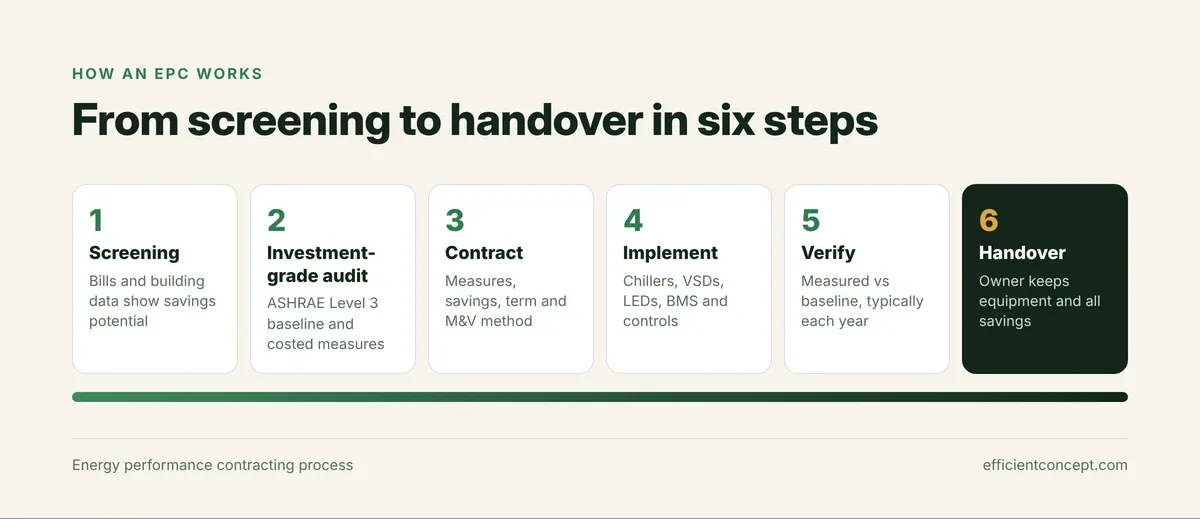
Six-step energy performance contract process from building screening and investment-grade audit to contract, implementation, measurement and verification, and handover
Screening. A quick review of bills and building data shows whether there's enough savings potential.
Investment-grade audit. A detailed ASHRAE Level 3 audit establishes the baseline and costs the measures. Read our guide to ASHRAE energy audit levels.
Contract. The parties agree the measures, the guaranteed or shared savings, the term and the M&V method.
Implementation. The ESCO installs the upgrades, such as chiller optimisation, LED lighting, variable speed drives, BMS upgrades and controls.
Measurement and verification. Savings are measured against the baseline, adjusted for weather and occupancy, typically each year.
Handover. At the end of the term, the owner keeps the equipment and 100% of the savings.
A worked example
An illustrative 20-year-old office building in Dubai has annual electricity costs of AED 3.0 million.
Audit findings: chiller plant optimisation, pump VSDs, LED lighting and BMS upgrades could save 25%, about AED 750,000 a year.
Project cost: AED 3.75 million.
Shared savings route: the ESCO funds the AED 3.75 million. For an illustrative seven-year term, the ESCO receives most of the verified savings and the owner receives the rest, with no upfront spend. After seven years, the owner keeps the full AED 750,000 a year.
Guaranteed savings route: the owner takes a green loan. The ESCO guarantees at least AED 700,000 a year in savings, which more than covers the loan repayments, and the owner keeps any surplus.
All figures are illustrative. Actual savings, terms and splits are set by each project's audit and contract.
Is an EPC right for your building?
EPCs work best when:
annual energy costs are significant, usually large commercial, hospitality, healthcare, education or government buildings
the building has at least several years of remaining life and stable use
utility data is available for at least 12 to 36 months
the owner can commit to a multi-year contract
They're less suited to small buildings with low energy bills, buildings facing demolition or major change of use, or projects where the owner wants full control of equipment choices.
Common mistakes
Weak baseline data. If the baseline is wrong, every savings calculation after it is wrong too. Invest in a proper investment-grade audit.
Vague M&V terms. Agree upfront how savings are measured, adjusted for weather and occupancy, and verified.
Ignoring tenant or occupancy changes. Contracts need clear rules for changes in floor area, use or operating hours.
Focusing only on the guarantee. Check the ESCO's track record, accreditation and maintenance obligations, not just the headline saving.
Forgetting operations. If building staff override new controls, savings disappear. Training is part of the project.
Frequently asked questions
What is an energy performance contract?
An energy performance contract is an agreement in which an energy services company (ESCO) implements energy-saving upgrades and the resulting savings pay for the project. The ESCO either funds the work and shares the savings, or guarantees a minimum level of savings.
What is the difference between shared savings and guaranteed savings?
In shared savings, the ESCO funds the project and recovers its investment from a share of the savings. In guaranteed savings, the owner funds the project and the ESCO guarantees a minimum saving, paying the difference if it isn't achieved.
What is Etihad ESCO?
Etihad Energy Services Company (Etihad ESCO) is a subsidiary of the Dubai Electricity and Water Authority (DEWA). It acts as a super ESCO that develops Dubai's energy efficiency retrofit market and works with accredited private ESCOs.
Do I need an energy audit before an EPC?
Yes. An investment-grade energy audit, typically ASHRAE Level 3, is needed to set the baseline and identify and cost the measures. The savings guarantee and M&V depend on it.
How long does an energy performance contract last?
Terms vary by project. They're set so that savings repay the investment, and commonly run for several years. After the term, the owner keeps all the savings and equipment.
How are savings verified?
Savings are measured against the agreed baseline using a measurement and verification (M&V) plan, usually based on the International Performance Measurement and Verification Protocol (IPMVP), with adjustments for weather and occupancy.
Final thoughts: let the savings pay for the upgrade
For many Dubai buildings, the biggest obstacle to a retrofit isn't the technology, it's the capital. Energy performance contracts remove that barrier and shift performance risk to the ESCO, as long as the baseline is solid and the contract is clear.
At Efficient Concept, we help building owners prepare for EPCs with investment-grade energy audits and energy modelling, so you go into the contract with a reliable baseline and a clear view of the savings available.
Considering a retrofit? Book a free initial consultation with our Dubai team, or call +971 52 710 0320.