
What Is ISO 50001?
By Qasim Virk 6 min read

Many UAE organisations have had an energy audit, implemented a few recommendations and saved money, only to watch consumption creep back up a year or two later. New staff override BMS schedules, setpoints drift and nobody is responsible for keeping savings in place.
ISO 50001 exists to stop that from happening. It turns energy efficiency from a one-off project into a management system with owners, targets, data and regular reviews.
Quick answer: ISO 50001 is the international standard for energy management systems (EnMS). It gives organisations a structured way to set an energy policy, identify their significant energy uses, set a baseline and performance indicators, set targets, act, monitor results and keep improving, following the Plan-Do-Check-Act cycle. The current version is ISO 50001:2018, amended in 2024 to address climate change. Organisations can implement it on their own or seek certification from an accredited body. In the UAE, it supports cost savings, ESG reporting and UAE climate law compliance.
What is ISO 50001?
ISO 50001 is published by the International Organization for Standardization (ISO). It doesn't tell you how much energy to use. Instead, it requires you to have a system for managing energy that leads to continual improvement in energy performance: efficiency, use and consumption.
It follows the same high-level structure as ISO 9001 (quality) and ISO 14001 (environment), so organisations already certified to those standards can integrate it easily. A 2024 amendment added a requirement to consider whether climate change is a relevant issue for the organisation, in line with other ISO management system standards.
Why ISO 50001 matters for UAE organisations
Lasting cost savings. In UAE buildings and facilities, energy, especially cooling, is often one of the largest controllable operating costs.
Evidence for reporting. An EnMS produces the reliable data needed for ESG disclosures and emissions reporting under the UAE climate law.
Credibility with banks and customers. Certification is recognised evidence of structured energy management, which helps in tenders, supply chains and sustainable finance.
Proven results. In a US Department of Energy programme combining ISO 50001 with verified performance, certified facilities improved energy performance by an average of about 10% per certification cycle.
What ISO 50001 requires: the Plan-Do-Check-Act cycle
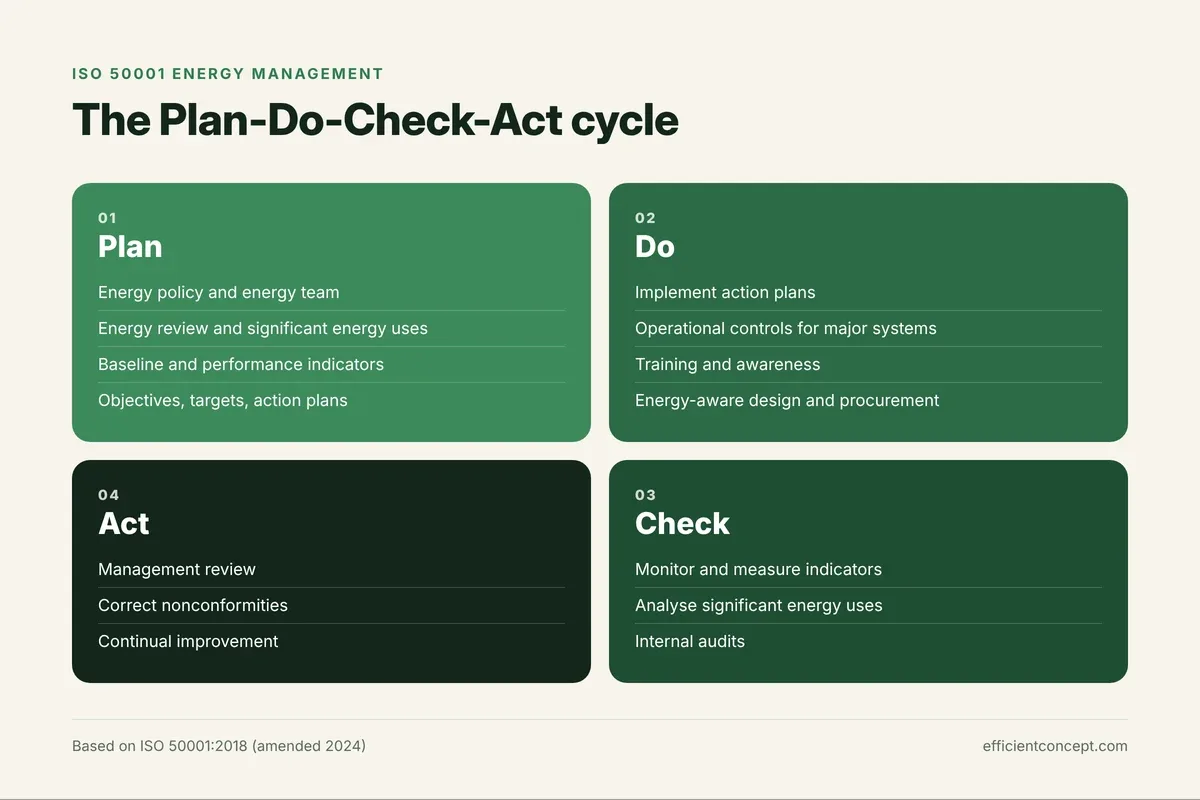
ISO 50001 Plan-Do-Check-Act cycle showing energy policy and energy review in Plan, action plans and operational control in Do, monitoring and internal audit in Check, and management review in Act
Plan
Energy policy signed by top management, committing to improve energy performance.
Energy management team with clear roles and authority.
Energy review: analyse energy use and consumption, and identify significant energy uses (SEUs), such as chillers, AHUs or production lines.
Energy baseline (EnB): a reference period against which improvement is measured.
Energy performance indicators (EnPIs): metrics such as kWh/m², kWh per guest night or kWh per tonne of product.
Objectives, targets and action plans.
Do
Implement action plans.
Set operational controls for SEUs, for example BMS schedules, chiller sequencing rules and setpoint limits.
Train staff and build awareness.
Consider energy performance in design and procurement of equipment and services.
Check
Monitor, measure and analyse EnPIs and SEUs.
Carry out internal audits of the EnMS.
Act
Top management reviews performance in a management review.
Correct nonconformities and drive continual improvement.
How to implement ISO 50001: a practical roadmap
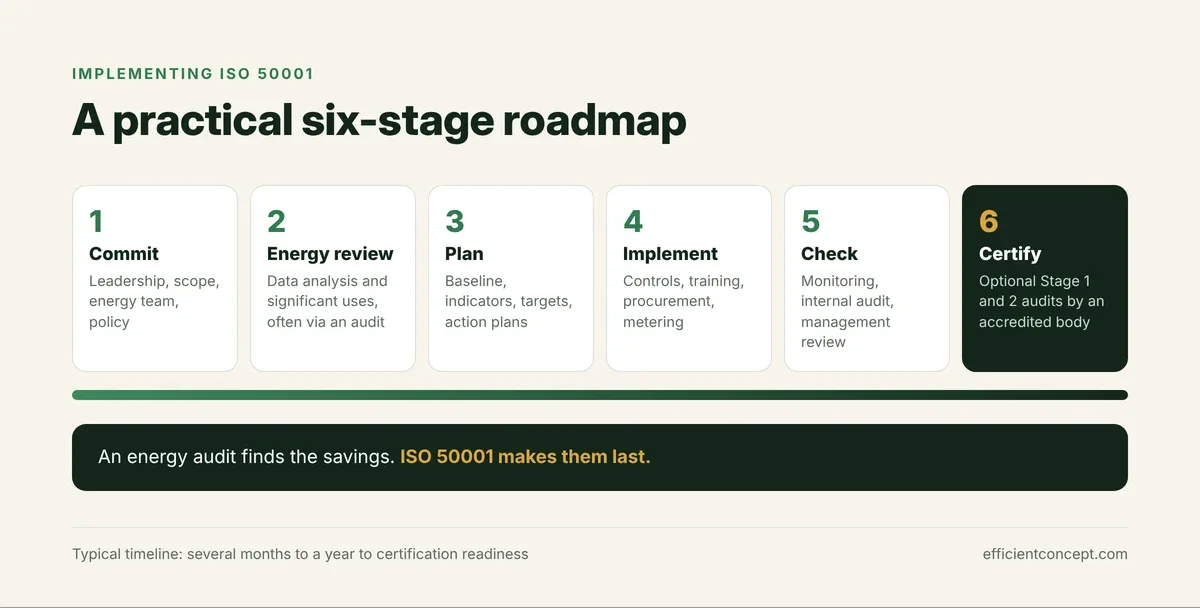
Six-stage roadmap for implementing ISO 50001 in a UAE organisation, from leadership commitment and energy review to certification audit
Stage | What happens | Typical output |
|---|---|---|
1. Commit | Leadership commitment, scope and boundaries agreed, energy team appointed | Energy policy, scope statement |
2. Energy review | Analyse 12–36 months of data and identify SEUs, often through an energy audit | SEU list, baseline, EnPIs |
3. Plan | Set objectives, targets and costed action plans | Energy objectives and action plans |
4. Implement | Operational controls, training, procurement criteria, metering improvements | Procedures, trained staff |
5. Check | Monitoring, internal audit, management review | Audit and review records |
6. Certify (optional) | Stage 1 and Stage 2 audits by an accredited certification body | ISO 50001 certificate |
Timelines vary with size and complexity, but many organisations take several months to a year to reach certification readiness.
ISO 50001 vs an energy audit
These two are often confused, but they're complementary.
Energy audit | ISO 50001 | |
|---|---|---|
What it is | A study at a point in time | An ongoing management system |
Main output | A list of savings opportunities | Policy, processes, targets and continual improvement |
Who owns it | Usually a consultant or engineer | The whole organisation, led by top management |
Timeframe | Weeks | Permanent |
An energy audit is often the best way to complete ISO 50001's energy review. Our guide to ASHRAE Level 1, 2 and 3 energy audits explains which level fits. The EnMS then makes sure the audit's recommendations are implemented and the savings last.
Common mistakes
Treating it as a paperwork exercise. The goal is better energy performance, not a binder of procedures.
Weak EnPIs. Total kWh alone doesn't account for weather, occupancy or production. Normalise your indicators.
Too many SEUs. Focus on the few systems that drive most consumption, such as cooling in most UAE buildings.
No metering plan. You can't manage what you can't measure. Sub-metering of major systems is often needed.
Leadership disengagement. Without top management review and resources, the system stalls.
Frequently asked questions
What is ISO 50001?
ISO 50001 is the international standard for energy management systems. It provides a framework for organisations to set an energy policy, measure energy performance, set targets and continually improve, using the Plan-Do-Check-Act cycle.
Is ISO 50001 mandatory in the UAE?
ISO 50001 is a voluntary standard. However, it helps organisations meet related requirements and expectations, such as emissions reporting under the UAE climate law, ESG disclosures and customer or tender requirements.
What is the current version of ISO 50001?
The current version is ISO 50001:2018. An amendment published in 2024 added climate change considerations, in line with other ISO management system standards.
What is the difference between ISO 50001 and ISO 14001?
ISO 14001 covers environmental management broadly, including waste, emissions and pollution. ISO 50001 focuses specifically on energy performance. Both share the same structure, so they can be integrated.
What are significant energy uses (SEUs)?
Significant energy uses are the equipment, systems or processes that account for a large share of energy consumption or offer major potential for improvement. In most UAE buildings, chillers and air handling systems are SEUs.
How long does ISO 50001 certification take?
It depends on the organisation's size and maturity. Many organisations take several months to a year to implement the system and complete Stage 1 and Stage 2 certification audits.
How much energy can ISO 50001 save?
Results vary. In a US Department of Energy programme combining ISO 50001 with verified energy performance, certified facilities improved energy performance by an average of about 10% per certification cycle.
Final thoughts: make savings stick
An energy audit tells you where the savings are. ISO 50001 makes sure you capture them and keep them. For UAE organisations facing rising expectations from regulators, lenders and customers, it's a practical way to turn energy into a managed, measurable part of the business.
At Efficient Concept, we support ISO 50001 journeys through energy audits for the energy review, baseline and EnPI development, and institutional capacity building to train in-house energy teams, especially in the public sector.
Thinking about ISO 50001? Book a free initial consultation with our Dubai team, or call +971 52 710 0320.