
AI in Building Energy Management: What Actually Works in UAE Buildings
By Qasim Virk 6 min read

Almost every building technology pitch in the UAE now mentions artificial intelligence. Some vendors promise that AI will cut your HVAC energy by a third or more, automatically. The reality is more useful, and more modest: AI is very good at some specific energy tasks, but it can't fix bad data, broken sensors or a building nobody understands.
This guide separates what works from what's hype, and explains what a UAE building needs in place before AI can deliver real savings.
Quick answer: AI in building energy management means using machine learning and advanced analytics on BMS, meter and weather data to find faults, optimise HVAC and chiller plant operation, forecast demand and spot waste. The most proven application is fault detection and diagnostics (FDD): in a large US Department of Energy campaign, buildings using FDD tools achieved median energy savings of about 9%. Larger savings are possible in some buildings, but results depend on good metering, reliable sensors and a well-understood baseline, which is why an energy audit is usually the right first step.
What does "AI energy management" actually mean?
The term covers several different technologies, often bundled together:
Energy analytics: dashboards and automated analysis of meter and BMS data.
Fault detection and diagnostics (FDD): software rules and machine learning that spot faults, such as a stuck valve, simultaneous heating and cooling or a chiller running outside its efficient range, and explain the likely cause.
Predictive optimisation: algorithms that adjust chiller sequencing, chilled water temperatures or AHU settings based on forecasts of weather and occupancy.
Demand forecasting: predicting tomorrow's load to plan plant operation, storage or demand response.
Generative AI assistants: newer tools that let facility teams ask questions about building data in plain language.
In UAE buildings, where cooling usually dominates electricity use, most of the value is in the chiller plant, air side and controls.
What AI does well today
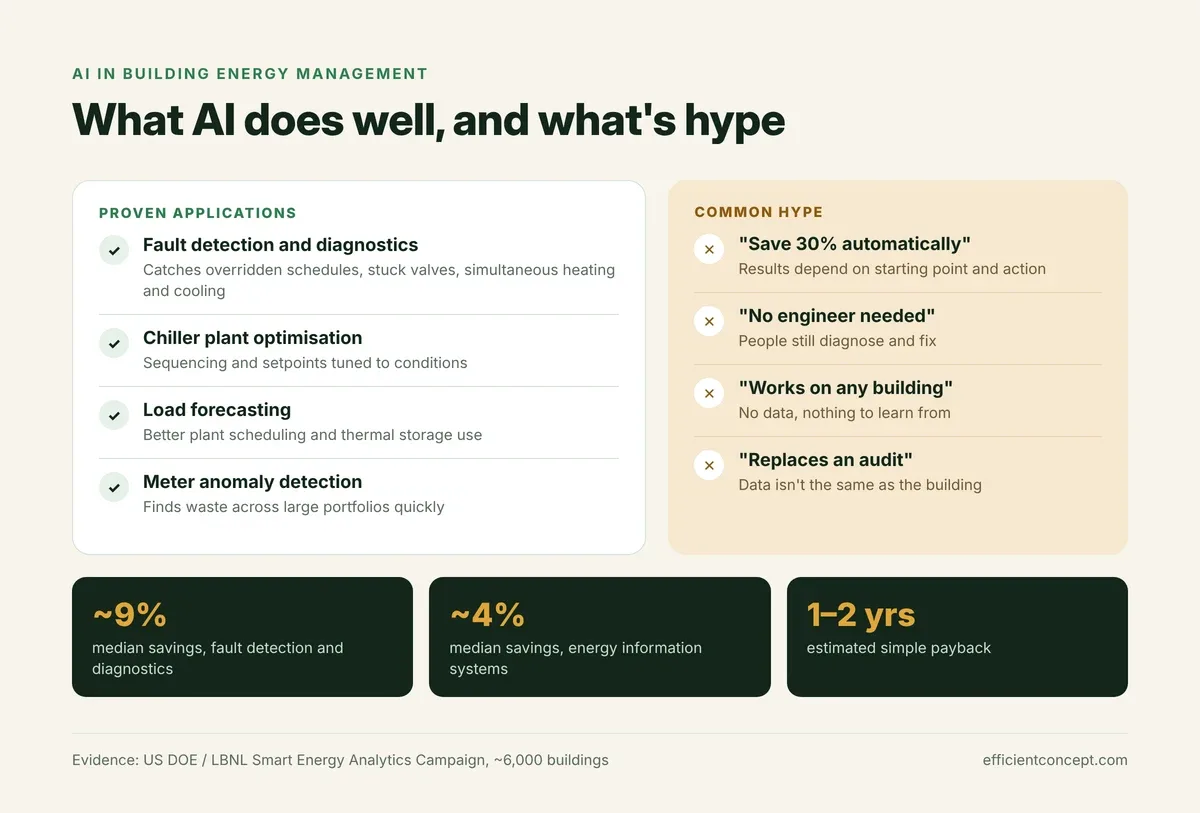
Overview of proven AI applications in building energy management, including fault detection and diagnostics, chiller plant optimisation, demand forecasting and energy analytics, compared with common hype
Application | What it does | Why it matters in UAE buildings |
|---|---|---|
Fault detection and diagnostics | Continuously checks BMS data for faults and wasteful operation | Catches overridden schedules, stuck valves and simultaneous heating and cooling that quietly waste cooling energy |
Chiller plant optimisation | Adjusts sequencing, chilled water and condenser water setpoints to current conditions | Chiller plants are often the single largest energy user |
Demand and load forecasting | Predicts cooling load from weather, occupancy and history | Supports better plant scheduling and thermal storage strategies |
Anomaly detection on meters | Flags unusual consumption at site, floor or tenant level | Finds waste across large portfolios quickly |
Predictive maintenance | Spots equipment degrading before it fails | Protects efficiency and comfort in extreme summer conditions |
What the evidence shows
The strongest independent evidence comes from the US Department of Energy's Smart Energy Analytics Campaign, run by Lawrence Berkeley National Laboratory. Across 96 organisations and about 6,000 buildings:
buildings using energy information systems (analytics and dashboards) achieved median savings of about 4%
buildings using fault detection and diagnostics achieved median savings of about 9%
initial analysis estimated a simple payback of around one to two years
These are medians, so some buildings saved much more. But they're a useful reality check against marketing claims. The biggest results usually come where buildings start with poor operation and staff act on what the software finds.
What's hype
"Install and save 30% automatically." Large savings are possible in some buildings, but they depend on the starting point, data quality and whether anyone acts on the findings.
"No need for an engineer." AI flags problems. People still have to diagnose root causes, fix equipment and keep controls in order.
"Works on any building." Without reliable sensors, meters and BMS integration, there's nothing for the AI to learn from.
"Replaces an energy audit." Analytics show what's happening in the data. An audit checks what's physically happening in the building.
The data AI needs before it can help
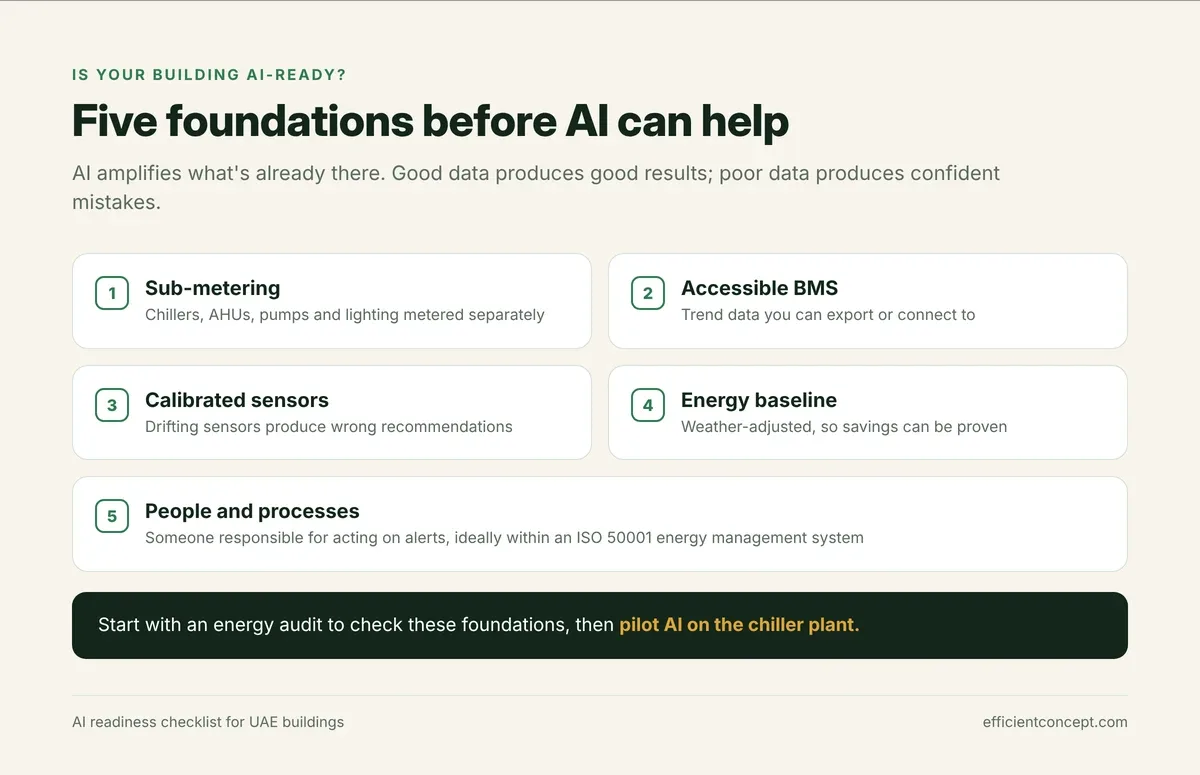
Readiness checklist for AI in building energy management covering metering, BMS data, sensor calibration, energy baseline and the people to act on findings
Before investing in AI, check that your building has:
☐ Sub-metering of major systems, at least chillers, AHUs, pumps and lighting
☐ An accessible BMS with trend data you can export or connect to
☐ Calibrated sensors, because a drifting temperature sensor produces confident but wrong recommendations
☐ An energy baseline for measuring whether savings are real
☐ People and processes to act on alerts
Many UAE buildings fall short on one or more of these. That doesn't mean AI is out of reach. It means the first investment should be in the foundations.
A sensible way to get started
Start with an energy audit. Understand where energy goes and fix obvious problems first. Our guide to ASHRAE Level 1, 2 and 3 energy audits explains the options.
Close the data gaps. Add sub-meters, fix sensors and organise BMS points.
Pilot on your biggest system. For most UAE buildings, that's the chiller plant.
Measure results properly. Compare against a weather-adjusted baseline, not last year's bill.
Build it into management. Make acting on alerts part of daily operations, ideally within an ISO 50001 energy management system.
Energy modelling also helps: a calibrated model can test whether an AI optimisation strategy is likely to pay back before you commit.
Common mistakes
Buying software before fixing basics. AI on top of faulty sensors and missing meters produces faulty conclusions.
Alert fatigue. Hundreds of unprioritised alarms get ignored. Rank faults by energy and cost impact.
No baseline. Without one, you can't prove the AI saved anything.
Ignoring cybersecurity. Connecting a BMS to cloud analytics needs proper IT security controls.
Assuming results transfer. A case study from a mild climate may not match a UAE building with year-round cooling.
Frequently asked questions
How is AI used in building energy management?
AI is used to analyse BMS, meter and weather data to detect faults, optimise HVAC and chiller plant operation, forecast energy demand, flag unusual consumption and predict equipment failures.
How much energy can AI save in buildings?
Results vary widely. In a US Department of Energy campaign covering about 6,000 buildings, fault detection and diagnostics tools achieved median savings of about 9%, and energy information systems about 4%. Some buildings save more, depending on their starting point.
What is fault detection and diagnostics (FDD)?
FDD is software that continuously analyses building system data to find faults and inefficient operation, such as stuck valves, sensor errors or equipment running out of schedule, and suggests likely causes.
Does AI replace an energy audit?
No. AI analyses data, while an energy audit examines the building and its systems physically, checks data quality and identifies savings measures. An audit is often the best first step before AI.
What data does AI energy management need?
It typically needs interval energy data, sub-metering of major systems, BMS trend data from calibrated sensors, weather data and a reliable energy baseline.
Is AI energy management suitable for UAE buildings?
Yes, especially for buildings with large chiller plants and a BMS, because cooling dominates energy use in the UAE. Success depends on good metering, reliable sensors and staff who act on the findings.
Final thoughts: smart buildings need sound foundations
AI is a powerful tool for keeping buildings efficient, especially in cooling-heavy UAE climates. But it amplifies what's already there: good data and good operation produce good results, while poor data produces confident mistakes. Get the foundations right first.
At Efficient Concept, we help UAE building owners prepare for smart energy management through energy audits that establish the baseline, check metering and data quality, and identify where analytics or AI will pay off, plus energy modelling to test strategies before you invest.
Wondering if your building is ready for AI? Book a free initial consultation with our Dubai team, or call +971 52 710 0320.